


Table of Contents
- How to Choose a Wedding Venue That Sets the Tone
- Crafting a Vision: Aesthetic, Personalization, and Guest Experience
- Luxury Wedding Budget Breakdown: Where the Money Goes
- Vendor Management and Logistics for Seamless Execution
- High-End Wedding Planning Checklist: Timeline and Milestones
- Sustainable Luxury and Technology Integration
- Legal and Insurance Considerations for Luxury Events
- Post-Wedding Legacy: Extending the Celebration
- Frequently Asked Questions
Last Updated: September 23, 2026
How to Choose a Wedding Venue That Sets the Tone
The right venue does more than hold your guests; it establishes the entire emotional register of the day, which is why tips for planning luxury weddings almost always start here. A ballroom with soaring ceilings and crystal chandeliers tells your guests to expect grandeur. A garden conservatory with soft, filtered light signals intimacy and romance. The space you choose locks in the aesthetic, the logistics, and the guest experience all at once, so it deserves your first and most careful attention.
Assess Capacity and Layout
Start with your guest count and work backward. A seated capacity of 80 guests feels generous for a dinner, but that same room holding 100 for a cocktail reception requires a completely different furniture plan. Walk the space with your list in hand and sketch where the band, the dance floor, and the head table will sit. If the layout forces your guests to squeeze past each other to reach the bar, the elegance evaporates.
Evaluate Included Amenities
Ask for an itemized list of what the venue provides versus what you must rent. Draping, up-lighting, lounge furniture, and staging are frequently billed as add-ons at other spaces, and those line items add up fast. A venue that includes professional lighting and venue draping removes two of the most expensive rentals from your budget before you’ve made a single call.
Crafting a Vision: Aesthetic, Personalization, and Guest Experience
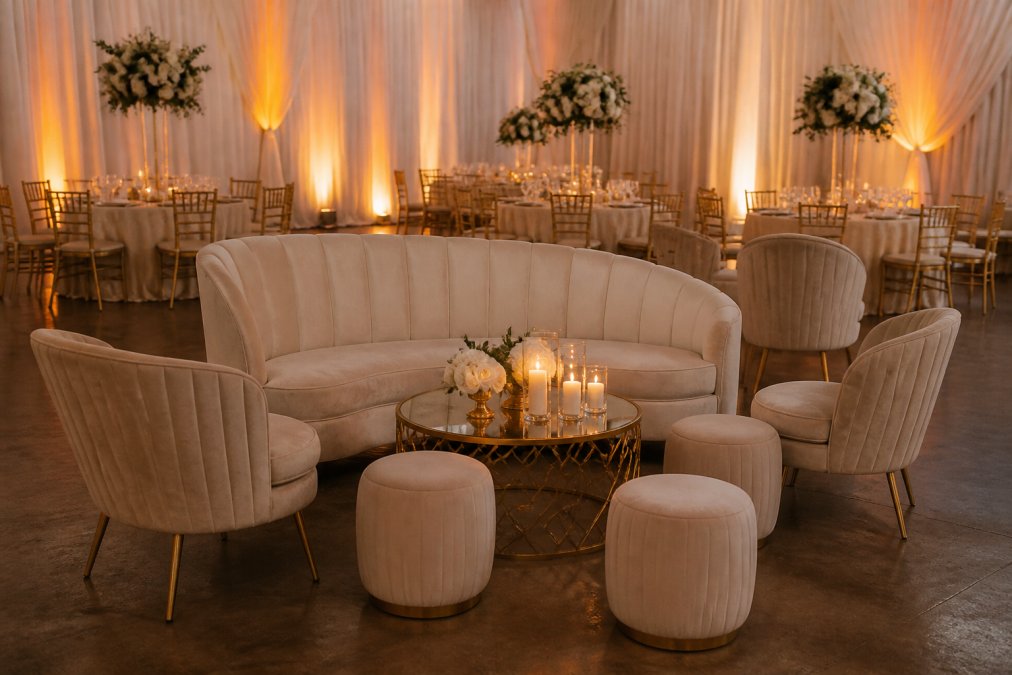
A luxury wedding vision is a single, coherent story told through color, texture, light, and hospitality. It is the difference between a room that looks expensive and a room that feels intentional. The most useful discipline is to write the vision down as a one-page creative brief before you book a single vendor, mood, palette, three adjectives, and the two or three moments guests should remember.
Personalization That Reads as Intentional, Not Theatrical
Personalization is where high-end events separate themselves from merely costly ones. The strongest moves are the ones guests can participate in rather than merely observe:
- Print menus in the couple’s shared language or a family heritage script, and add a short translation line so no guest feels excluded.
- Commission a signature cocktail tied to the story of how you met, and name it something only your inner circle will recognize.
- Assign seating that deliberately mixes generations and friend groups rather than clustering by age, this is the single highest-leverage hospitality decision at a seated dinner.
- Add a handwritten note at each place setting for your closest guests, and a printed program for everyone else so no one feels left out of the in-joke.
- Build one “quiet room”, a lounge or terrace with seating, water, and lower music, for guests who need a break from the main floor.
Guest Comfort Is the Invisible Thread
Seating that lets older relatives rest near the dance floor, a coat check that actually functions, and staff who anticipate a refill before it’s requested all read as sophistication. Grandeur without hospitality is just decoration. Two practical tests: walk the room at eye level from the back, not from the photographer’s angle, and ask whether it still feels warm; then count the number of steps between the farthest guest seat and the nearest restroom.
The most common mistake we see is couples designing the room for photographs and forgetting the room will be experienced in person. Stand at the back of the space at eye level, not from the photographer’s angle, and ask whether it still feels warm.
Sustainable Luxury: The Differentiator Most Guides Skip
Sustainable luxury is the practice of choosing quality and longevity over disposability, and it is becoming a defining marker of sophisticated events. Reusable linens, locally grown and in-season florals, rented furniture instead of purchased, and a menu built around what regional growers actually have available all reduce waste without reducing elegance. Ask your florist to design with foam-free mechanics and to donate or compost arrangements after the event; ask your caterer about food-rescue partnerships in your area.
Technology That Disappears Into the Background
Technology now carries much of the guest experience, but the goal is technology that never interrupts the room. A private event app can hold the schedule, the seating chart, and the menu in one place. Digital RSVPs and QR-coded welcome cards cut printing and speed up check-in. For guests who cannot attend, a live stream of the ceremony keeps them present, and a discreet drone or second-unit camera can capture establishing shots the primary photographer can’t reach.
Luxury Wedding Budget Breakdown: Where the Money Goes
A luxury wedding budget breakdown typically splits across venue, catering, florals, entertainment, attire, and planning, with the venue and catering usually consuming the largest share. Everything else flexes around those two fixed costs. The single most useful habit is to set the total number first, then allocate percentages rather than dollar amounts, percentages survive scope creep, dollar amounts don’t.
Allocating Funds for Maximum Impact
Spend where guests will physically touch and feel the difference, and save where they won’t notice. Guests remember the food, the comfort of their seat, and the lighting. They rarely remember the calligraphy on the escort cards. It’s often recommended to reserve a contingency of roughly ten percent for the surprises that always appear in the final weeks, and a further five percent for vendor gratuities and overtime hours that are easy to forget when signing contracts.
| Category | Typical Share of Budget | Where to Prioritize |
|---|---|---|
| Venue and rentals | Largest single block | Layout, lighting, draping |
| Catering and bar | Second largest | Food quality, service staff |
| Florals and decor | Mid-range | Statement pieces, not every surface |
| Entertainment | Mid-range | Band or DJ, sound quality |
| Attire and beauty | Flexible | Fit over label |
| Planning and coordination | Fixed | Day-of logistics |
| Contingency | Reserve fund | Last-minute changes |
The Costs Couples Forget to Budget For
The line items that blow up a luxury budget are rarely the headline vendors. They are the quiet ones: service charges and administrative fees that many venues and caterers add on top of the quoted per-person price; state and local sales tax on catering and rentals; valet or shuttle transportation for guests; lighting and sound technicians who bill by the hour; and the cost of a second-day brunch or welcome party if you’re hosting one.
A quoted per-person catering price is almost never the number you pay. Service charges commonly run in the high teens to low twenties as a percentage, and sales tax applies on top in most states. Build both into your spreadsheet from day one.
Where Luxury Budgets Actually Get Wasted
Over-investing in florals on every surface instead of two or three statement installations, upgrading the bar to top-shelf liquor that most guests won’t distinguish, and paying for a larger guest count than desired are common areas where luxury budgets can be wasted. Trimming the guest list can often fund an entire upgrade elsewhere and improve the experience for everyone who remains.
Decide your top three “non-negotiables” before you build the spreadsheet. Protect those line items at all costs and let everything else flex. Couples who do this consistently report less regret than couples who try to optimize every category equally.
Vendor Management and Logistics for Seamless Execution
Vendor management is the discipline of keeping your caterer, florist, photographer, band, and venue on one timeline with one point of contact. When five vendors each hold a slightly different schedule, the day frays at the seams.
Here is how to keep everyone aligned:
- Build a single master timeline and distribute it to every vendor at least two weeks out.
- Assign one coordinator, not the couple, as the sole point of contact on the day.
- Confirm load-in and load-out windows in writing for each vendor.
- Schedule a walkthrough with your caterer and florist in the actual space.
- Collect certificates of insurance from every vendor before the event.
Skipping the vendor walkthrough is the fastest way to discover on the day that your florist’s arch doesn’t fit through the service entrance. Confirm access routes, power locations, and ceiling height before contracts are signed.
High-End Wedding Planning Checklist: Timeline and Milestones
A high-end wedding planning checklist works backward from the date, giving each vendor and decision its own runway. Rushing any stage is where quality quietly drops.
- 12 months out: Set the budget, book the venue, and hire your planner.
- 9 months out: Secure catering, band, and photographer.
- 6 months out: Finalize florals, attire, and the guest list.
- 4 months out: Send invitations and plan the menu tasting.
- 2 months out: Confirm the master timeline and vendor load-in windows.
- 1 month out: Final headcount, seating chart, and payment schedule.
- 1 week out: Distribute the timeline and hold the final walkthrough.
Finishing logistics ahead of schedule can contribute to a calmer wedding day.
Sustainable Luxury and Technology Integration
Sustainable luxury is the practice of choosing quality and longevity over disposability, and it is becoming a defining marker of sophisticated events. Reusable linens, locally grown florals, and rented furniture instead of purchased all reduce waste without reducing elegance.
Legal and Insurance Considerations for Luxury Events
Legal and insurance planning protects an event of significant value, and it is the section most couples skip until something goes wrong. Standard steps include securing event liability insurance, confirming the venue’s own coverage, and reading every vendor contract for cancellation and force majeure terms.
A few items deserve a careful read:
- Liability coverage: Confirm whether the venue requires you to carry a policy and what limit it specifies.
- Vendor contracts: Check deposit refund terms, cancellation windows, and overtime rates.
- Alcohol service: Verify who holds the liquor liability and whether licensed bartenders are required.
- Force majeure: Understand what happens if weather or another event forces a postponement.
Post-Wedding Legacy: Extending the Celebration
Post-wedding legacy is what remains after the last guest leaves: the photographs, the relationships strengthened, and the traditions started. Luxury events increasingly extend beyond a single evening. A next-day brunch, a private anniversary dinner, or a curated photo album all carry the celebration forward.
Frequently Asked Questions
What is the 50/20/30 rule for weddings?
The 50/20/30 rule is a budgeting guideline that allocates 50% of your total wedding budget to the venue and catering, 20% to photography, entertainment, and flowers, and 30% to attire, transportation, and miscellaneous expenses. For luxury weddings, you may adjust these percentages based on your priorities, but the principle helps ensure you don’t overspend in one area. Always confirm what your venue package includes to avoid hidden costs.
What defines a luxury wedding experience?
A luxury wedding experience is defined by personalization, exceptional service, and attention to detail. It often includes bespoke floral design, curated cuisine, high-end venue amenities like professional lighting and draping, and seamless logistics that allow guests to feel pampered. The focus is on creating an intimate, sophisticated atmosphere that reflects the couple’s story, rather than just spending more money.
How far in advance should you start planning a luxury wedding?
Most luxury weddings require 12 to 18 months of planning to secure top venues and vendors. Popular dates and high-end professionals book quickly, so starting early gives you the best selection. If you’re planning a luxury wedding in the D.C. metro area, begin by researching venues that match your guest count and aesthetic, then build your vendor team around their availability. A high-end wedding planning checklist can help you stay on track.
What role does professional lighting and draping play in wedding aesthetics?
Professional lighting and draping transform a space by creating ambiance and highlighting architectural features. Up-lights can wash walls in color, while draped fabric adds softness and grandeur. These elements also guide guest flow and can make a large room feel intimate. When choosing a venue, ask about included lighting and draping packages, as these can significantly affect your overall design and budget.