


Table of Contents
- Start With Your Event Basics and Budget
- Explore Small Party Venues and Venue Types
- Understanding Event Venue Rental Prices
- Search and Compare Venues Systematically
- Free Event Space and Budget-Friendly Options
- Selecting an Event Venue Capacity for 100 Guests
- Negotiate, Book, and Finalize Your Venue
- Frequently Asked Questions
Last Updated: October 10, 2026
Start With Your Event Basics and Budget
Finding affordable event venues starts with knowing what you actually need. Before you search anywhere, sit down and define three things: your guest count, your date range, and your total budget. These three decisions eliminate 80% of unsuitable options immediately.
Skipping this step wastes weeks on unsuitable spaces. Start with constraints, not aesthetics.
Your budget determines everything else. When you know your total spend, you can work backwards to figure out what’s realistic. If you have $5,000 for an event with 75 guests, you’re looking at roughly $65-70 per person for the venue alone. That number helps you filter options fast. Write down your maximum hourly rental rate or per-person cost right now. This becomes your first filter.
Separate your “must-haves” from your “nice-to-haves” early. Must-haves might be: parking, climate control, and AV capability. Nice-to-haves might be: in-house catering or a built-in dance floor. Knowing the difference saves you money and stress.
Explore Small Party Venues and Venue Types
Small party venues come in many varieties. Understanding your options helps you find affordable event venues that match your actual needs.
The main types are:
- Community centers and public facilities, Often the cheapest option. Many municipalities rent rooms by the hour with minimal fees.
- Studios and lofts, Raw spaces you customize. Lower base cost but you handle setup and breakdown.
- Party rooms at restaurants or bars, Built-in tables, chairs, sometimes bar service. Cost varies widely by location.
- Parks and outdoor shelters, Extremely affordable if weather works. Bring your own tables, chairs, and sometimes tent.
- Event halls and banquet spaces, Higher cost but often include tables, chairs, linens, and basic setup.
Each type has different hidden costs. A community center might be $200 but requires you to bring everything; a restaurant party room might be $500 but includes tables and service. The cheapest upfront price isn’t always the cheapest total cost. List three types that fit your guest count and event style, then research two options in each category.
Understanding Event Venue Rental Prices
Venue rental prices vary by location, day of week, time of year, and what’s included. The advertised rate is almost never the final cost, hidden fees and add-ons can increase your bill by 30-50% or more.
Most venues charge one of three ways:
- Hourly rental. You pay per hour. Typical range for small spaces: $50-300 per hour depending on location and amenities.
- Flat daily rate. Fixed price regardless of how many hours you use it. Common for all-day events or full-day packages.
- Per-person pricing. The venue charges based on headcount. Usually includes tables, chairs, and basic service.
The Hidden Fees Checklist
Request a complete price breakdown that includes every line item below:
Rental and Access Fees
- Base rental rate (hourly, daily, or per-person)
- Setup and breakdown fees (often $100-500 each)
- Early arrival or late departure charges (typically $50-150 per hour)
- Parking fees ($5-15 per vehicle or flat lot fee)
Equipment and Furnishings
- Tables and chairs ($3-10 per person if not included)
- Linens and place settings ($2-5 per person)
- Lighting, staging, or sound system ($100-1,000)
Service and Staffing
- Mandatory service charge or gratuity (typically 18-22% of food/beverage)
- Bartender or beverage service fee ($200-400)
- Cleanup or trash removal ($100-300)
Restrictions and Requirements
- Minimum food or beverage spend (common in restaurants and bars)
- Mandatory in-house catering (may cost 30-50% more than outside caterers)
- Damage deposit (often $200-1,000, refundable)
Taxes and Surcharges
- Sales tax (varies by location, typically 6-10%) (2026 Sales Tax Rates)
- Facility or venue tax (some municipalities add 1-3%)
Calculate Your True Total Cost
Here’s how to compare venues fairly:
- Get a written quote that lists every fee above. Do not rely on phone estimates.
- Add up all line items, including taxes and service charges.
- Divide by your guest count to find the true per-person cost.
- Compare apples to apples. A $200 hourly space with no setup fee and included tables might cost $15 per person for 100 guests. A $150 hourly space with $300 setup, $500 equipment rental, and $1,000 catering minimum could cost $25 per person for the same event.
Never accept a quote without asking: “What is and isn’t included in this price?” and “Are there any other fees I should expect?” Many venues quote a low base rate then add $30-50 per person for tables, chairs, and linens. Get everything in writing before you book, and ask the venue to itemize what’s included in their “package” versus what costs extra.
For affordable event venues, the lowest advertised rate is often not the lowest total cost. Always calculate the full price before you decide.
Search and Compare Venues Systematically
Use a repeatable search process and comparison framework to find affordable event venues and evaluate them consistently.
The Five-Step Search Process
- List your top 3-5 venue types. Pick the categories that match your budget and style (community center, restaurant party room, park shelter, loft, event hall, etc.).
- Search online directories and local sources. Use Google Maps, community center listings, chamber of commerce directories, and word-of-mouth recommendations.
- Call and ask the key questions. Guest capacity, available dates, base rental rate, what’s included, setup/breakdown fees, parking, cancellation policy, and vendor restrictions.
- Request a written quote. Never rely on a phone conversation. Ask the venue to email a full breakdown of all fees, what’s included, cancellation terms, and payment schedule.
- Visit your top 3 choices in person. Photos and virtual tours mislead. See the space, test the lighting, check parking and restroom facilities, and assess how it feels for your event type.
The Venue Comparison Worksheet
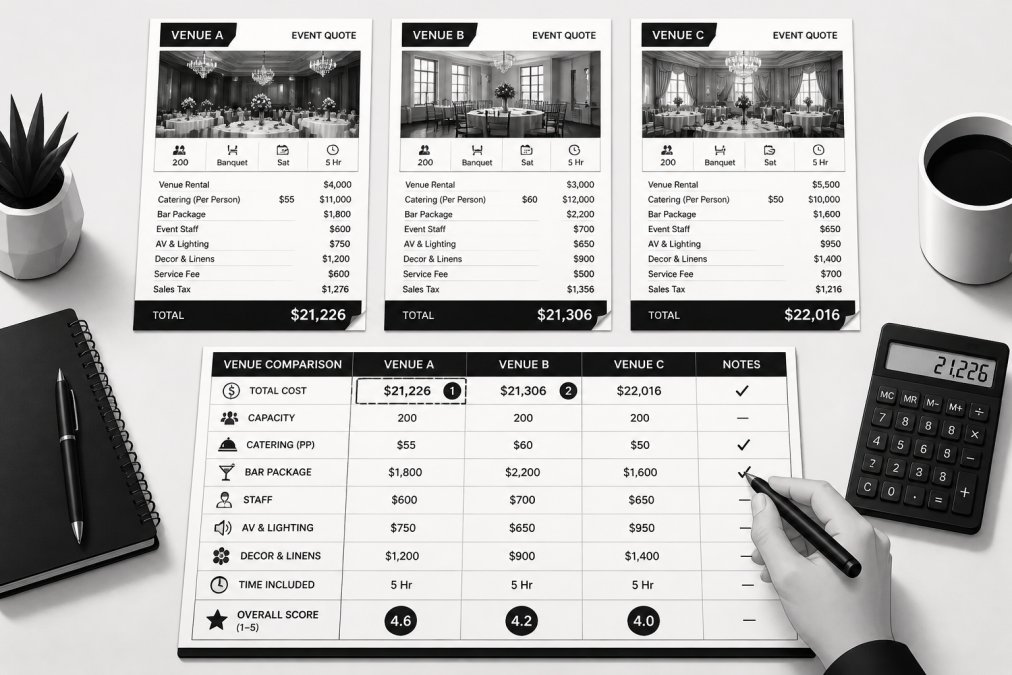
Use this framework to evaluate and compare venues side-by-side. Print it or create a spreadsheet:
Basic Information
- Venue name and contact
- Address and neighborhood
- Available dates and times
- Guest capacity (stated and realistic)
Cost Breakdown
- Base rental rate (hourly, daily, or per-person)
- Setup and breakdown fees
- Equipment rentals (tables, chairs, linens, AV)
- Service charges or gratuity
- Parking fees
- Total estimated cost for your event
- Cost per guest (total ÷ guest count)
Practical Logistics
- Free parking available? (Yes / No / Limited)
- Number of parking spaces or lot capacity
- Public transit nearby? (Yes / No)
- Accessible entrance and restrooms? (Yes / No / Partial)
- Loading dock or easy equipment entry? (Yes / No)
- Climate control (heat and AC)? (Yes / No)
- Restroom capacity (number of stalls)
- Built-in AV or sound system? (Yes / No / Cost extra)
Vendor and Booking Flexibility
- Can you bring your own caterer? (Yes / No / Fee applies)
- Can you bring your own DJ or entertainment? (Yes / No / Fee applies)
- Can you bring your own florist or decorator? (Yes / No / Fee applies)
- Alcohol policy (BYOB / in-house only / licensed outside vendors allowed)
- Minimum food or beverage spend required? (Yes / No / Amount)
Contract and Risk
- Cancellation policy (full refund / partial / non-refundable)
- Days notice required to cancel without penalty
- Damage deposit required? (Yes / No / Amount)
- Does venue carry liability insurance? (Yes / No)
- Do you need to carry your own liability insurance? (Yes / No)
- Setup and breakdown time windows (e.g., 2 hours before, 1 hour after)
Your Assessment
- Overall gut feeling (1-5 stars)
- Best feature for your event
- Biggest concern or drawback
- Rank this venue (1st choice, 2nd choice, etc.)
How to Use the Worksheet to Find Affordable Venues
Compare your top venues on three dimensions:
1. True Total Cost. Look at the “cost per guest” row. A venue with a low base rate but high add-ons may cost more than one with a higher base rate but more included.
2. Practical Fit. Check parking, transit, accessibility, and restroom capacity. A cheap venue 30 minutes from transit or with inadequate parking will frustrate guests and cost more in ride-share fees.
3. Flexibility and Risk. Review vendor policy and cancellation terms. A venue charging $500 to bring your own caterer might force expensive in-house catering. Strict cancellation policies could cost you the entire deposit if you reschedule.
The venues you don’t see in online searches are often cheaper than the ones you do. Ask your local chamber of commerce, nonprofit organizations, community centers, and parks departments for recommendations. Word-of-mouth often surfaces affordable event venues that don’t show up in Google Maps or venue directories. Many community spaces and church halls rent for $100-300 per day but are rarely advertised online.
::: Exploring these hidden corners of a neighborhood often reveals unique event spaces that provide character and cost savings for your gathering.
This process takes 3-4 hours but saves you from expensive mistakes and ensures you book a venue that truly fits your budget, your guests’ needs, and your event vision.
Free Event Space and Budget-Friendly Options
Free or nearly-free event space exists if you know where to look: public parks ($20-100/day), library meeting rooms (free or $25-50/hour), nonprofit community centers, church halls ($100-300), university spaces, and restaurant private rooms (free with food/drink minimum). The trade-off is setup and cleanup responsibility. Calculate the true cost before you commit, a free park with tent rental might cost less than a $400 banquet hall.
Selecting an Event Venue Capacity for 100 Guests
Choosing the right capacity matters. A venue too small feels cramped; too large feels empty and wastes money. For 100 guests, aim for a stated capacity of 100-120.
Key capacity considerations:
- Seated events, Need more space per person. Aim for 15-20 square feet per guest.
- Standing/cocktail events, Need less space. Aim for 8-10 square feet per guest.
- Mixed format, Some sitting, some standing. Plan for 12-15 square feet per guest.
Venues state capacity as cocktail (standing) and seated. The seated number is usually 30-40% lower. For 100 guests with mixed dining and mingling, look for a space that seats 80-100 comfortably.
Negotiate, Book, and Finalize Your Venue
Once you’ve narrowed to your top 2-3 affordable event venues, negotiate. Most venues have flexibility on price, especially for off-peak dates. Here’s how:
- Ask directly about flexibility on off-peak dates.
- Offer a longer commitment (book a future event at full price for a discount now).
- Ask what’s negotiable (setup fees, tables, etc.).
- Get everything in writing with every charge, what’s included, cancellation terms, and payment schedule.
Before you sign, verify cancellation policy, insurance requirements, setup/breakdown times, parking availability, and vendor restrictions.
Read the contract carefully. Look for automatic price increases, mandatory service charges, or hidden fees. If something feels off, ask before you sign. Most venues are willing to clarify or adjust terms.
M Lounge provides professional lighting and draping, ensuring every detail of your event runs smoothly.
Finding affordable event venues takes planning but saves money and stress. Start by defining your budget and guest count. Explore different venue types. Compare prices systematically. Consider free or low-cost options. Choose the right capacity for your guest count. Then negotiate confidently and get everything in writing.
The best affordable event venue is one that fits your budget, accommodates your guests comfortably, and lets you focus on your event, not logistics. M Lounge offers exactly that: a premier space designed for your special occasion, with professional amenities and dedicated event planning support. Reserve now to secure your date and transform your vision into an unforgettable celebration.
Frequently Asked Questions
What is a reasonable budget for an affordable event venue?
Budget depends on guest count, location, date, and amenities. Weekday events and off-peak seasons typically cost less than weekend bookings. Community centers and outdoor park shelters offer the most cost-effective options, while private studios and lofts fall in the mid-range. Request quotes from multiple venues to establish realistic pricing for your event type and location.
How do I find free event space in my area?
Free event space is available through community centers, public parks with pavilions or shelters, libraries, and nonprofit organizations. Many parks offer free reservations for small gatherings, though some charge nominal fees for amenities like tables or setup. Contact your local parks department or community center to inquire about free or low-cost options available in your neighborhood.
What size venue do I need for 100 guests?
For 100 guests, plan for 10-15 square feet per person in a seated format, requiring roughly 1,000-1,500 square feet. Cocktail-style events need 7-10 square feet per person. Confirm the venue’s stated capacity and visit in person to ensure the space feels comfortable for your event type, accounting for tables, bars, dance floors, and guest flow.
Are event venues cheaper during weekdays or off-peak seasons?
Yes. Weekday events typically cost 20-40% less than weekend bookings. Off-peak seasons (January-March, September-October) and non-holiday times also offer better rates. Ask venues about flexible rental discounts, shoulder-season pricing, and package deals when booking outside peak demand periods.