



Table of Contents
- Why Event Planners Seek a Carrington Alternative for Corporate Events
- Corporate Event Venue Selection Criteria: What Matters Most
- Event Venue Amenities Checklist for Professional Gatherings
- M Lounge: A Boutique Carrington Alternative for Corporate Events
- How to Plan a Corporate Retreat in an Intimate Venue
- Comparing Boutique Venues vs. Large Conference Centers
- Common Mistakes to Avoid When Booking Corporate Event Spaces
- Conclusion: Reserve Your Corporate Event Date
- Frequently Asked Questions
Last Updated: September 6, 2026
Corporate event planners in the D.C. metro area are increasingly seeking a Carrington alternative for corporate events, not because the well-known venue lacks polish, but because their needs have shifted toward intimacy, flexibility, and a more boutique aesthetic. At M Lounge, we specialize in this kind of sophisticated gathering, offering an opulent space for medium-sized professional functions.
Most guides get the search for a corporate events venue wrong by treating it like a wedding booking. The decision-making criteria are different, the technical requirements are stricter, and the return-on-investment calculation is tied to business outcomes.
Why Event Planners Seek a Carrington Alternative for Corporate Events
The primary driver is the mismatch between large, traditional ballrooms and the need for a more controlled, intimate environment. For a corporate retreat of 80 people or a holiday party for 100, a cavernous hall feels empty and impersonal.
Another reason is the quality of in-house coordination. When you book a space that handles hundreds of weddings a year, your corporate breakfast meeting is often treated as a secondary priority.
Corporate Event Venue Selection Criteria: What Matters Most
The best corporate event venue selection criteria prioritize infrastructure over square footage. You need reliable audiovisual equipment, stable Wi-Fi for presentations, and a floor plan that supports both plenary sessions and breakout networking.
Accessibility is another critical factor. According to the Americans with Disabilities Act standards, venues must accommodate guests with mobility challenges. For a business gathering, this includes wheelchair routes to all meeting facilities and accessible presentation stages. If your team is coming from Annapolis or the D.C. metro area, you also need to consider parking capacity and proximity to major transit routes.
Event Venue Amenities Checklist for Professional Gatherings
When touring a space, use a structured event venue amenities checklist to avoid missing details that impact your agenda. Start with the basics: seating capacity, table configurations, and customizable floor plans.
But for corporate events, the checklist must go deeper than the wedding-focused amenities directories typically list. The following items are the technical and operational differentiators that separate a venue capable of hosting a seamless board meeting or training session from one that merely looks good in photos.
- Audiovisual Equipment: Built-in projectors, screens, and sound systems with technical support on-site. For corporate use, verify the projector’s lumens rating (1800+ for well-lit rooms), screen resolution (1080p minimum), and whether the sound system includes lapel microphones for presenters and a dedicated channel for Q&A sessions (projectorcentral.com). Ask if the venue supports simultaneous HDMI and wireless presentation inputs so multiple laptops can be queued without cable swapping.
- Network Infrastructure: This is the most overlooked item in corporate venue selection. A single shared Wi-Fi network will fail when 80 attendees each connect two devices. Ask whether the venue has a dedicated business-grade internet connection with a service-level agreement, separate SSIDs for guests and presenters, and wired Ethernet drops at the podium and breakout tables. For hybrid meetings, verify the upload bandwidth (at least 10 Mbps dedicated) to support stable video conferencing without pixelation (zoom.us).
- Furniture Quality: Ergonomic seating for long sessions and lounge furniture for networking spaces. For a 6-hour training session, standard banquet chairs cause fatigue by hour three. Ask about chair specifications, look for padded seats with lumbar support, and whether the venue can provide height-adjustable tables for interactive workshops.
- Climate Control: Independent thermostat zones for breakout rooms. A common failure point is a single HVAC zone that makes one room freezing while another is stuffy. Confirm that each meeting space has its own thermostat and that the venue can pre-condition rooms to your preferred temperature before attendees arrive.
- Security: Secure entry points for confidential board meetings. This includes not just locked doors but also the ability to control access to specific floors or wings, secure storage for laptops and sensitive documents, and a policy for cleaning staff access during your event.
- Backup Power: Generator availability to prevent mid-presentation outages. Ask for the generator’s transfer time, a 10-second gap is acceptable; a 10-minute gap is not. Also verify that the AV system and network equipment are on the backup circuit, not just the lights.
- Acoustics and Sound Isolation: For confidential discussions or video recordings, verify that meeting rooms have sound-isolating walls and that the HVAC system does not create a constant hum that interferes with microphone pickup. Ask if the venue has acoustic panels or if they can be rented.
- Loading and Setup Logistics: Corporate events often involve shipping materials, banners, or product samples. Confirm the venue has a loading dock or ground-level entrance, freight elevator access, and a secure holding area for deliveries that arrive before your setup crew.
Skipping the technical infrastructure check is the most common mistake. Verify that the venue has a hard-wired internet connection for your CEO’s keynote, not just shared Wi-Fi that will buckle under 80 connected devices. Ask for a speed test during your site visit, run it at the same time of day as your event, and request the venue’s network diagram if they claim dedicated bandwidth.
Send your IT lead or AV coordinator on the site visit with a checklist that includes these items. They will spot issues that a general event planner might miss, such as insufficient power outlets near seating areas or a lack of cable management that creates trip hazards.
M Lounge: A Boutique Carrington Alternative for Corporate Events
M Lounge is our top recommendation for planners seeking a sophisticated alternative that prioritizes the guest experience. Located in Capitol Heights and Bowie, MD, this venue is designed for medium-sized events, offering a seated capacity of 80 guests and a cocktail capacity of 100 guests.
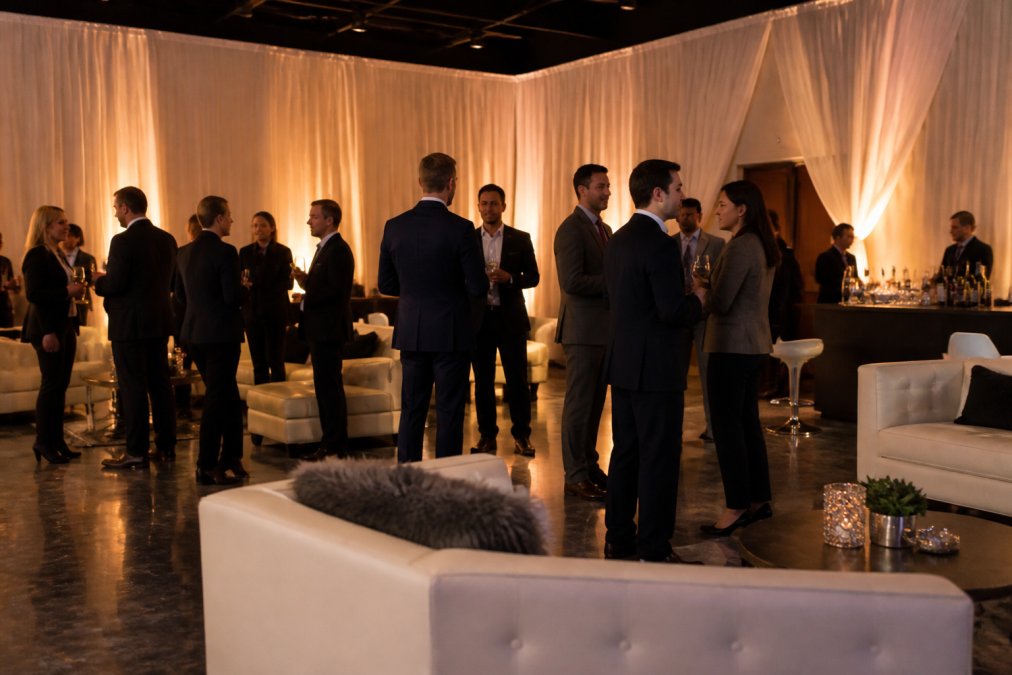
The value proposition is the combination of opulent ambiance and full-service planning. The venue provides luxurious venue draping and mesmerizing up-lights that transform the space from a blank room into a branded environment that impresses clients and employees alike.
Capacity and Layout for Medium-Sized Events
The layout at M Lounge is designed to maximize interaction without sacrificing comfort. For a corporate retreat, the floor plan can be arranged for theater-style presentations in the morning and converted to banquet rounds for lunch, with lounge furniture deployed for afternoon breakout discussions.
Technical Infrastructure and Audiovisual Equipment
While the aesthetic is luxurious, the technical backbone supports professional presentations. The venue’s event infrastructure accommodates standard AV needs.
Catering and Dietary Flexibility
Professional catering is a must, but dietary flexibility is what separates a good venue from a great one.
How to Plan a Corporate Retreat in an Intimate Venue
Planning a corporate retreat in an intimate venue requires a different rhythm than a large conference. Start by defining your objectives: is this a strategic planning session, a team-building exercise, or a client appreciation event?
A successful retreat agenda allocates 60 to 90 minutes for working sessions, followed by 20-minute networking breaks. In an intimate venue, these breaks are where the real value emerges, as employees from different departments actually connect. planning corporate events.
Ask the venue for a site visit during an actual [corporate event](/intimate-corporate-event-venues-maryland/), not just an empty showing. Seeing the space active with professional lighting and draped tables gives you a realistic sense of the ambiance and acoustics.
Comparing Boutique Venues vs. Large Conference Centers
The choice between a boutique venue and a large conference center comes down to control and experience. Large centers offer scale, but they often lack the personalized service that makes a business gathering memorable.
| Comparison Factor | Boutique Venue (M Lounge) | Large Conference Center |
|---|---|---|
| Capacity | Up to 100 guests | 500+ guests |
| Atmosphere | Intimate, opulent | Expansive, impersonal |
| AV Support | Dedicated, in-house | Often third-party required |
| Catering | Flexible, tailored menus | Standardized packages |
| Event Coordination | Full-service planning | Limited, self-managed |
| Best For | Retreats, board meetings | Large expos, conventions |
For a corporate holiday party or a mid-year strategy session, the boutique option wins on attendee experience.
However, the comparison that corporate planners actually need goes beyond atmosphere and capacity. It requires a return-on-investment (ROI) analysis tied to the specific outcomes of a business gathering.
Measuring ROI: What Your Venue Choice Costs and Returns
For a corporate training session or board meeting, the venue cost is typically a small fraction of the total investment. The larger costs are attendee salaries, travel, and the opportunity cost of taking people away from their daily work.
A practical ROI calculation for a 1-day corporate retreat with 30 attendees at an average loaded salary of $800 per day:
- Total attendee cost: $24,000
- Boutique venue rental: $3,000-$5,000 (typical for a full-day buyout)
- Large conference center rental: $1,500-$3,000 (for a comparable meeting room)
If the boutique venue enables just one additional productive hour per attendee (for example, by avoiding a 45-minute AV setup delay and a 30-minute lunch overrun), that is 30 additional productive hours worth $3,000, which offsets the entire rental premium.
The Hidden Costs of Large Conference Centers
Large centers often quote a low base rate but add mandatory fees that boutique venues bundle into their pricing. Common line items include:
- AV labor: $150-$300 per hour for a technician, with a 4-hour minimum, even if you only need a microphone check.
- Internet access: $200-$500 per day for dedicated bandwidth, which is sometimes not included in the room rate.
- Setup and teardown labor: Union or in-house crew charges that apply even for simple table rearrangements.
- Catering minimums: Food and beverage minimums that force you to overspend on meals you did not plan for.
- Loading dock fees: Charges for using the freight entrance, plus waiting time for the single service elevator.
A boutique venue that offers itemized transparency can help eliminate these surprises.
The Productivity Angle: What the Layout Enables
Beyond cost, the layout directly affects meeting outcomes. A large conference center with 20-foot ceilings and a 200-person ballroom can feel overwhelming for a 30-person strategy session. Attendees spread out, sightlines are poor, and the acoustics create echoes.
For hybrid meetings, the comparison is even starker. Large centers often have a single “hybrid room” with a fixed camera setup, while the rest of the meeting rooms lack adequate lighting for video.
When comparing venues, calculate the total cost per productive attendee-hour, not the raw rental price. A venue that costs $2,000 more but saves 30 minutes of setup time and keeps attendees comfortable for an extra hour of working session is the better financial choice for most corporate outcomes.
A final consideration is the post-event debrief. Large centers often have back-to-back bookings that require you to vacate immediately. A boutique venue with a dedicated rental window that includes buffer time allows your team to hold a 20-minute wrap-up session in the same space.
Common Mistakes to Avoid When Booking Corporate Event Spaces
One frequent error is underestimating the time needed for setup and teardown. Corporate events often run on tight schedules, and if the venue requires you to vacate by 5 PM for an evening wedding, your post-event debrief gets cut short.
Another mistake is failing to clarify the pricing structure. Many venues advertise “all-inclusive” rates but then add fees for basic items like draping, lighting, or setup labor.
Conclusion: Reserve Your Corporate Event Date
Securing the right venue for your corporate events is about matching the space to the outcome you want to achieve. A large hall might impress by volume, but a boutique venue like M Lounge impresses through detail, offering the professional atmosphere and technical support your team needs to execute flawlessly.
Frequently Asked Questions
What features should I look for in a corporate event venue?
Focus on the corporate event venue selection criteria that directly affect your agenda. Prioritize a floor plan that supports your format, whether that is theater-style seating for 80 or networking space for 100. Check the quality of the audiovisual equipment, including microphones and presentation screens. Also assess the professional atmosphere and whether the space provides a private setting for board meetings or team-building sessions without distractions.
How do I compare luxury event spaces for business meetings?
Build an event venue amenities checklist and score each property against it. Include capacity, lighting, draping, lounge furniture, and catering flexibility. Ask about technical infrastructure such as Wi-Fi bandwidth and built-in AV. Request a site visit to evaluate the professional atmosphere firsthand. Compare how each venue handles event logistics, from load-in to breakdown. Finally, request a detailed quote that lists all services to understand the full investment before you compare packages.
What are the benefits of choosing a boutique event space over a large conference center?
A boutique venue like M Lounge offers a more controlled and intimate environment for corporate retreats and board meetings. Staff can provide full-service planning rather than routing you through a large convention team. The aesthetic, including venue draping and up-lighting, creates a polished backdrop that suits award ceremonies and holiday parties. You also get the entire space for your group, which strengthens networking and keeps attendees focused on your agenda.
How far in advance should I book a corporate event venue?
For a sought-after boutique venue, start your search 6 to 12 months ahead, especially if your dates fall in peak season. If your timeline is shorter, such as 4 to 6 weeks out, contact the venue directly to check availability. Have your attendee count and preferred dates ready so the events team can confirm capacity and walk you through the booking process without delay.
What is included in a full-service corporate event package?
Full-service planning typically covers event coordination, vendor management, and setup and breakdown logistics. At a venue like M Lounge, the package includes the space, luxurious draping, lounge furniture, and up-lighting to create the desired ambiance. Ask whether the technical infrastructure, such as AV equipment, is built in. Request a written proposal that itemizes every service so there are no surprises beyond the quoted amount.
Planning a successful corporate retreat or holiday party comes down to finding a partner who understands professional logistics as well as aesthetics. M Lounge combines an intimate capacity, luxurious draping, and professional up-lighting with a dedicated coordination team to ensure your event runs without surprises. Get started with M Lounge and reserve your date for an event that reflects your company’s standards.