



Table of Contents
- Luxury vs. Traditional Venue Differences
- What Is Included in Luxury Venue Packages
- Key Factors Influencing Venue Pricing
- How to Compare Venue Packages: A Pricing Comparison Template
- Questions to Ask Luxury Event Venues Before You Sign
- The Value of All-Inclusive Services and Total Cost of Ownership
- Frequently Asked Questions
Last Updated: September 11, 2026
Luxury vs. Traditional Venue Differences
The core difference between luxury and traditional venues is what you’re actually buying: a traditional venue rents you a room, while a luxury venue sells a finished experience. That distinction drives every line item that follows. Traditional spaces typically hand over four walls and a bare floor, leaving you to source tables, linens, lighting, and staff. Luxury venues bundle the atmosphere into the booking.
A traditional hall might quote a low site fee, then leave you paying separately for rentals, setup labor, and decor. A luxury space folds those into one agreement, which is exactly why comparing luxury event venue packages requires reading past the headline number.
The most common mistake is comparing a traditional venue’s base rental rate against a luxury venue’s all-inclusive package price. You are not comparing the same thing. The traditional quote excludes rentals, labor, and lighting; the luxury quote usually includes them.
That gap is where budgets quietly break. Below, we break down what luxury packages actually contain, how pricing is structured, and how to compare them without getting burned.
What Is Included in Luxury Venue Packages
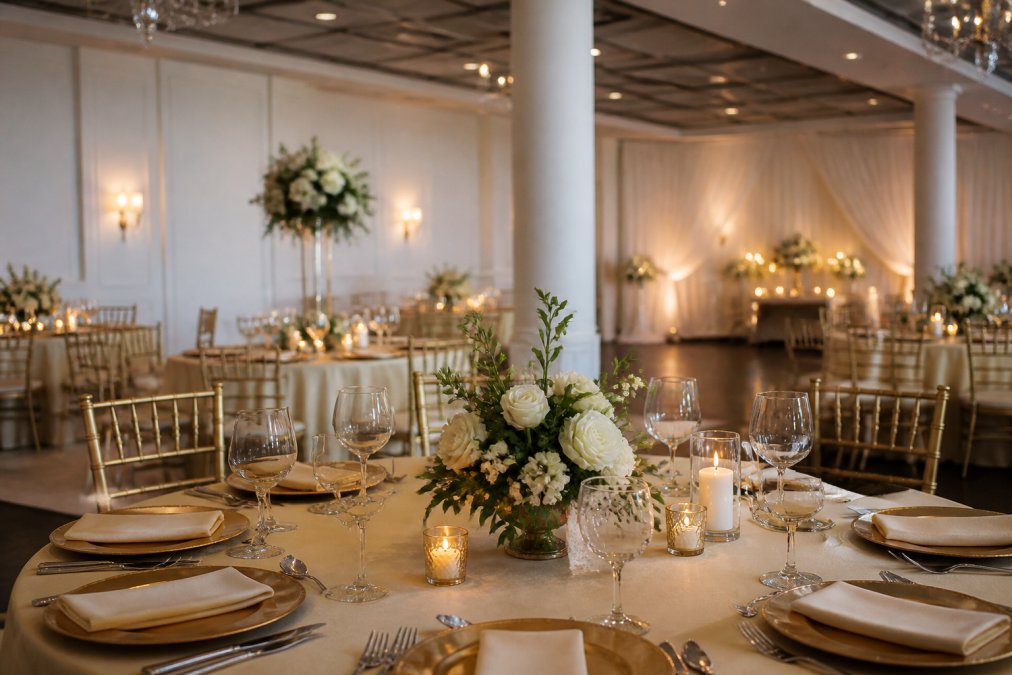
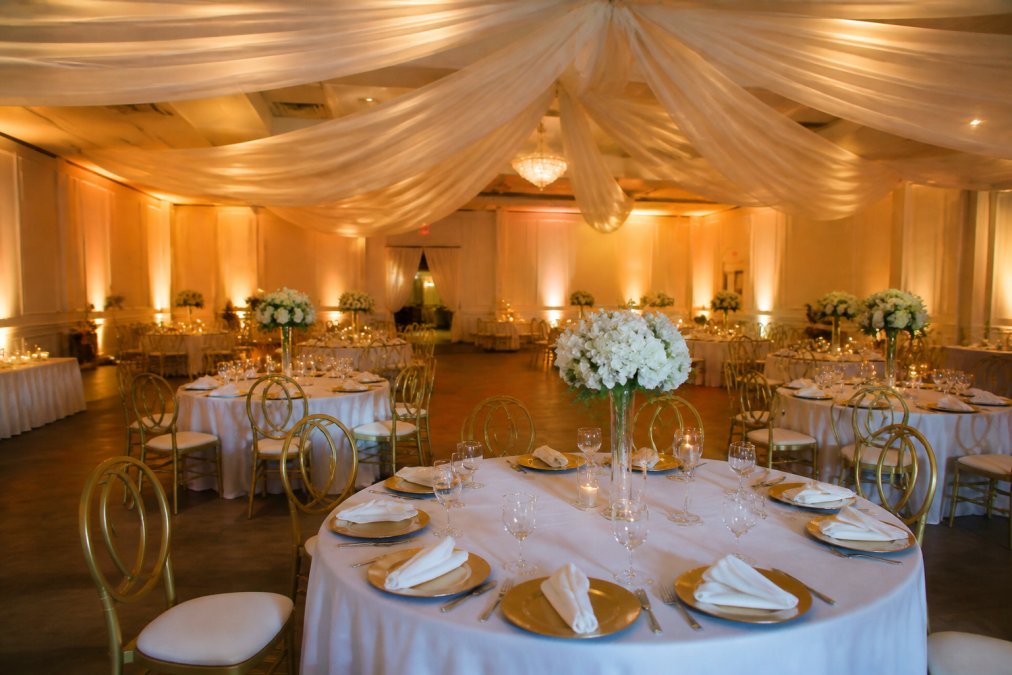
Luxury venue packages generally include the physical space, in-house ambiance features, and at least some coordination. At M Lounge, for example, bookings come with venue draping, professional lounge furniture, and up-lighting built into the space itself.
The inclusions that matter most are the ones that would otherwise become line items. Draping, lounge seating, and architectural lighting are the three most commonly outsourced. When a venue owns them, you eliminate both the rental cost and the delivery-and-setup coordination.
The Luxury Wedding Venue Amenities Checklist
Use this checklist to score any venue’s package before you sign:
- Draping or ceiling treatment included
- Lounge furniture on site, not rented
- Up-lighting or architectural lighting
- Setup and cleanup handled by the venue
- Day-of coordination contact assigned
- Catering minimums stated in writing
- Vendor exclusivity rules disclosed
- Overtime and service charge terms defined
Key Factors Influencing Venue Pricing
Venue pricing is influenced by five factors: capacity, date, day of week, inclusion depth, and vendor flexibility. Capacity sets the floor because it determines staffing and catering minimums. Date and season drive the largest swings, since peak-season Saturdays command the most demand.
Inclusion depth is the factor most buyers underweight. A package that includes draping, lighting, and furniture removes three vendor contracts and their associated labor. That is real money, even when the headline rate looks higher. hiring event entertainment.
Average Cost of Wedding Venues and Budget Allocation
Rather than quote a national average that will not match your market, use this allocation framework. A common approach is to reserve roughly half of your total event budget for the venue and catering combined, then divide the remainder across photography, attire, florals, and entertainment (theknot.com). M Lounge does not publish fixed pricing because cost depends on guest count, date, and inclusions, so request a current quote directly.
| Budget Line | Typical Share | What It Covers |
|---|---|---|
| Venue and catering | ~50% | Space, food, beverage, service |
| Photography and video | ~12% | Coverage, editing, album |
| Florals and decor | ~10% | Centerpieces, installations |
| Attire and beauty | ~9% | Dress, suit, styling |
| Entertainment | ~8% | DJ or band, lighting |
| Stationery and misc. | ~11% | Invitations, favors, transport |
How to Compare Venue Packages: A Pricing Comparison Template
Comparing luxury event venue packages fairly means converting every quote into one number: all-in cost per guest. Site fees, catering minimums, and service charges are quoted on different bases, so a side-by-side of headline rates tells you almost nothing. Normalize first, then compare.
Step 1: Convert Every Quote to the Same Basis
Ask each venue for five figures in writing:
- Site fee, flat, or tiered by room or time block?
- Catering minimum, a dollar floor, a per-person minimum, or both?
- Service charge, what percentage, and is it applied before or after tax?
- Rentals, lighting, and decor, included, or billed through a preferred vendor?
- Setup, cleanup, and overtime, included, or hourly?
A venue that quotes a $6,000 site fee with a $12,000 catering minimum is not cheaper than one quoting a $15,000 all-inclusive package. It is the same number with more risk attached.
Step 2: Build the All-In Comparison Table
Fill every row for every venue before you rank them. Leave nothing blank, an empty cell is a question, not a zero.
| Line Item | Venue A | Venue B | Venue C |
|---|---|---|---|
| Site fee | |||
| Catering minimum (or actual F&B spend) | |||
| Service charge (%) | |||
| Rentals (tables, linens, chairs) | |||
| Lighting and draping | |||
| Setup and cleanup | |||
| Overtime (per hour, if triggered) | |||
| Coordination or planner fee | |||
| Total | |||
| Guests | |||
| All-in cost per guest |
Step 3: Apply the Service Charge Correctly
The service charge is the line most often misread. A 22% service charge on a $20,000 food-and-beverage total adds $4,400, and in many contracts it is calculated before sales tax, then taxed again (irs.gov). Ask the coordinator to show the math on a sample invoice. If they cannot, that is your answer.
Step 4: Stress-Test the Minimum
Catering minimums are usually a dollar floor, not a per-person guarantee (peer-reviewed research). If your guest count drops, you still owe the minimum. Model two scenarios: your target headcount and a conservative one 15% lower. The venue whose minimum still clears at the lower count is the safer contract.
Step 5: Score the Inclusions You Would Otherwise Rent
Draping, lounge furniture, and architectural lighting are the three items most commonly outsourced. Price them separately, rental, delivery, setup, and teardown, then subtract that total from the luxury venue’s quote. That adjusted figure is the only honest comparison.
The venue with the lowest site fee is frequently the most expensive overall. Normalize to all-in cost per guest, stress-test the minimum, and price the inclusions you would otherwise rent. Fill in every row before you decide.
Questions to Ask Luxury Event Venues Before You Sign
Ask about vendor exclusivity first, because it is the clause that most often forces you into a preferred list with higher prices. Then confirm service charges, overtime rates, and what happens if your guest count drops below the catering minimum.
Contractual red flags to watch for:
- Service charges that are not itemized
- Overtime billed at an undisclosed hourly rate
- A non-refundable deposit with no stated cancellation tiers
- Vendor exclusivity with no opt-out
- Setup or breakdown fees added after signing
Ask for the full fee schedule in writing before you commit. Verbal assurances do not survive a change in management.
The Value of All-Inclusive Services and Total Cost of Ownership
All-inclusive pricing wins on total cost of ownership, not on headline rate. But “TCO” is only useful if you can actually calculate it. Most buyers never do, which is why the cheapest-looking quote so often becomes the most expensive event.
The TCO Calculator: Eight Lines to Add
Total cost of ownership is the sum of everything you pay to produce the event, divided by your final guest count. Add these eight lines for each venue:
- Site fee, flat or tiered
- Food and beverage spend, actual, not the minimum, if you expect to exceed it
- Service charge, the percentage, applied to the correct base
- Rentals, tables, chairs, linens, glassware, flatware
- Lighting and draping, rental, delivery, setup, teardown
- Setup and cleanup labor, venue staff or your own crew
- Coordination, planner fee, or the value of your own hours
- Overtime and contingency, a realistic buffer for overruns
Divide the total by your confirmed guest count. That per-guest figure is the only number worth comparing across venues.
The Hidden Cost Most Buyers Miss: Coordination Labor
When a venue manages vendor communication and the event timeline, you are not paying a separate planner to reconcile five vendors. A traditional venue that hands over a bare room shifts that labor to you, sourcing rentals, chasing delivery windows, directing setup, and running the timeline on the day. That is real work, and it is the line item that never appears on a quote.
For a corporate retreat or an intimate gathering of 80 seated guests, a single point of contact is worth more than the discount on a bare room. M Lounge hosts seated events for 80 and cocktail receptions for 100, which suits medium-sized exclusive gatherings.
Contractual Red Flags: A Checklist Before You Sign
No top-ranking comparison article gives you a contract checklist. Use this one. Ask for the full agreement and read these clauses before you commit:
- Service charge transparency, is the percentage stated, and is the calculation base defined?
- Cancellation tiers, are refunds graduated by date, or is the deposit simply non-refundable?
- Force majeure, does it cover weather, public health orders, and venue-side closures, and does it trigger a refund or a reschedule?
- Vendor exclusivity, is there an opt-out, and what is the buy-out fee if you bring your own caterer or DJ?
- Overtime rate, stated per hour in writing, or billed at an undisclosed rate?
- Setup and breakdown fees, included, or added after signing?
- Guest-count adjustments, how far in advance can you lower the count, and what is the floor?
- Insurance requirements, does the venue require you to carry event liability coverage, and at what limit?
Verbal assurances do not survive a change in management. Get the fee schedule and the cancellation terms in writing.
Sustainability as a Service-Quality Signal
Ask each venue for its sustainability practices: linen reuse programs, LED or low-wattage lighting, food-waste reporting, and whether it works with caterers who donate surplus.
Run the TCO calculator on your top two venues before you negotiate. Walking in with an all-in per-guest figure, and a list of the contract clauses you need clarified, changes the conversation from “what does it cost” to “what does this include.”
The venues worth your deposit are the ones that answer the TCO question before you ask it.
Frequently Asked Questions
What should be included in a luxury event venue package?
A comprehensive luxury venue package typically includes site fees, tables, chairs, linens, setup and cleanup, venue coordination, and often decor bundles like draping and up-lighting. All-inclusive packages may also cover catering, bar service, and day-of coordination. Ask for a written breakdown of every inclusion and whether service charges or gratuity are built into the quoted price. M Lounge, for example, provides venue draping, lounge furniture, and up-lights as part of its luxury amenities.
How do you compare event venue pricing structures?
Request itemized quotes from each venue and place them side by side using a pricing comparison template. List site fees, catering minimums, service charges, rental inclusions, and overtime rates in separate columns. This reveals the true cost rather than the headline price. Venues with lower site fees often make up the difference through vendor exclusivity requirements or per-head charges, so compare the total projected spend for your guest count, not just the base rental rate.
What are the hidden costs in luxury event venue contracts?
Common hidden costs include overtime charges, setup and cleanup fees, security deposits, coat check, valet parking, and required vendor lists that eliminate cheaper outside options. Some contracts also add administrative fees or peak season pricing surcharges. Read the contractual obligations section carefully and ask whether the quoted price includes tax, gratuity, and service charges. A venue that provides contract transparency upfront saves you from budget surprises later.
Is it better to choose an all-inclusive luxury venue or a blank canvas?
All-inclusive venues reduce event logistics headaches because catering, decor, and coordination are bundled into one contract. A blank canvas gives you full creative control but requires you to source and manage every vendor separately. For most hosts planning a wedding or milestone celebration, all-inclusive packages offer better value once you account for the labor hours and vendor coordination costs. The right choice depends on your budget allocation and how much time you want to spend managing vendors.
How far in advance should you book a luxury event venue?
For peak season dates in spring and fall, booking 9 to 12 months ahead is standard. Holiday parties and popular weekend dates fill even earlier. If your timeline is shorter, ask about availability and whether the venue can handle a 4 to 6 week turnaround without cutting corners on quality. Venues with dedicated event management teams can often accommodate tighter timelines because their vendor relationships and setup processes are already in place.
Comparing luxury event venue packages comes down to one discipline: pricing the whole event, not the room. M Lounge handles that math for you with venue draping, professional lounge furniture, and up-lighting included in the space, plus a seated capacity of 80 and cocktail capacity of 100 for weddings, Quinceaneras, corporate retreats, and milestone celebrations. Reserve now with M Lounge and host your next event in a space built to remove the hidden costs before they appear.