




Last Updated: November 9, 2026
Quick Summary
Venue insurance requirements are the coverage terms a venue sets in its contract, typically including general liability limits, additional insured status, and a certificate of insurance submitted by a deadline. You must meet these terms before signing, and the venue can cancel your date if proof is missing or rejected.
- A venue’s own commercial policy typically excludes damage caused by a tenant or event host.
- The certificate of insurance is a one-page summary proving your policy exists and showing its key terms.
- A certificate holder receives notice of your policy, while an additional insured is granted coverage under it.
- Submit proof of insurance to the venue at least 2-3 weeks before the event.
- A rejected COI is usually a fixable mismatch, so get the specific deficiency in writing.
Table of Contents
- Why Venues Require Proof of Insurance Before Your Event
- Event Liability Insurance: The Coverage Your Venue Contract Expects
- The Event Insurance Certificate of Insurance: Reading Your COI Line by Line
- Venue Additional Insured Requirements and Coverage Limits Explained
- One-Day Event Insurance Cost: What Drives the Premium
- What Event Insurance Covers and What It Leaves Out
- When a Venue Rejects Your COI and How to Fix It
- Building Your Coverage Timeline Before You Reserve the Date
- Frequently Asked Questions
Why Venues Require Proof of Insurance Before Your Event
A venue’s requirement for proof of insurance is a risk-transfer mechanism: the venue owner wants written confirmation that if a guest is injured or the building is damaged during your event, someone else’s policy responds before their own does.
A venue carries its own commercial policy, but that policy typically excludes damage caused by a tenant or event host.
Watch out: the most common mistake is treating the COI as paperwork to handle the week of the event. Venues usually want it weeks earlier, and a rejected certificate takes time to correct.
Event Liability Insurance: The Coverage Your Venue Contract Expects
Event liability insurance is a policy that covers third-party claims of bodily injury, personal injury, and property damage arising from your event.
Two versions exist. A special event policy covers a single event on a single date, which is what most hosts need. A general liability policy covers ongoing operations and is what a business or vendor typically already carries.
What matters is that the policy responds to claims made against you as the event host. Confirm the policy names the event date and location, because a policy written for the wrong date covers nothing.
The Event Insurance Certificate of Insurance: Reading Your COI Line by Line
The event insurance certificate of insurance is a one-page summary, issued by your insurer or broker, that proves your policy exists and shows its key terms.
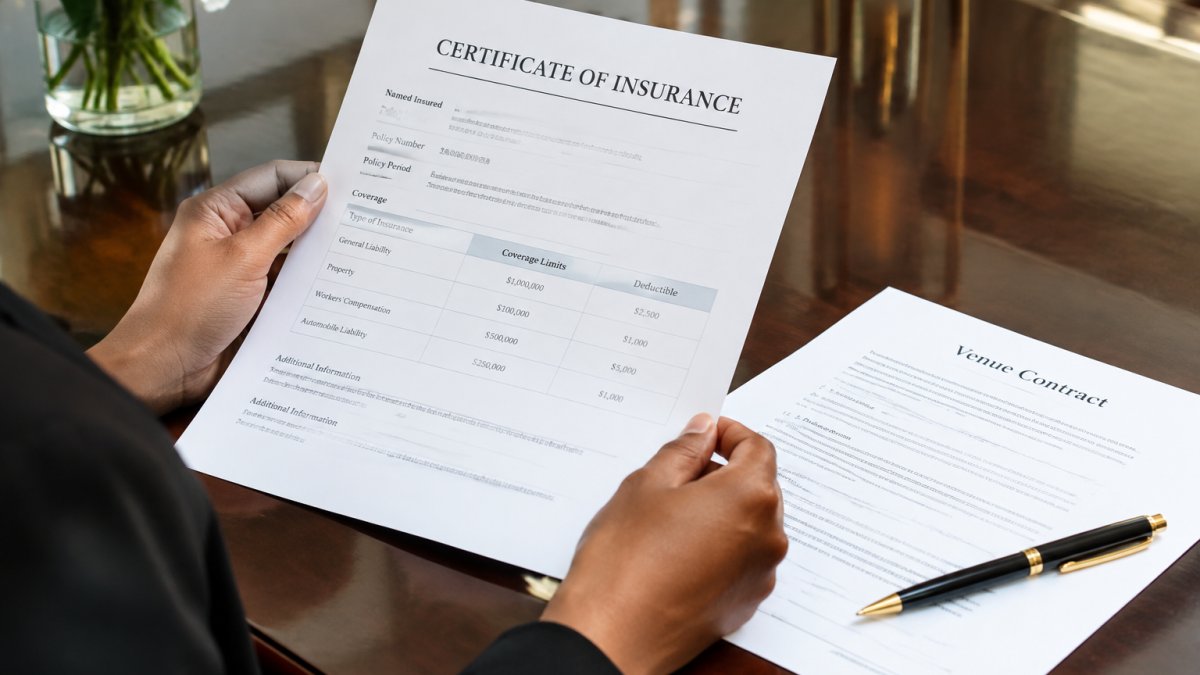
Four lines matter most. The insured name must match the person or entity signing the venue contract. The policy period must include your event date plus setup and teardown. The coverage limits must meet the venue’s stated minimums. The certificate holder and additional insured sections must list the venue exactly as its legal name appears in the contract.
A common mistake is submitting a certificate that lists the venue as certificate holder but not as additional insured. Those are different statuses, and venues that require additional insured status will reject the certificate.
Additional Insured vs. Certificate Holder: What the Difference Means for You
A certificate holder receives notice that your policy exists. An additional insured is granted coverage under your policy for claims connected to your event.
If the venue contract says “additional insured,” your insurer must add an endorsement to the policy. Some insurers do this routinely for special event policies; others charge or decline. Ask before you buy.
Best for: hosts whose contract uses the phrase “additional insured” and names a submission deadline.
Skip if: your contract only asks for proof of insurance, in which case certificate holder status may be enough.
Venue Additional Insured Requirements and Coverage Limits Explained
Venue additional insured requirements vary by venue type, event activity, and jurisdiction, and the contract is the controlling document.
Start by pulling the insurance clause out of the contract and marking four things: the required general liability limit, whether additional insured status is required, whether liquor liability is required, and the submission deadline. Everything else in the clause is usually boilerplate. If the clause cites an endorsement form number, write it down; that number tells your broker exactly what the venue expects.
Activity drives the limits more than venue size does.
Jurisdiction matters because insurance regulation and premises liability rules can differ by location. Check with your venue and insurer for the requirements that apply to your event.
A workable comparison method is to build a one-page grid before you shop.
Before signing, it helps to know which contract terms to raise with the venue manager. Our guide to questions to ask wedding venue managers covers the capacity, contract, and insurance questions worth settling early.
One-Day Event Insurance Cost: What Drives the Premium
One-day event insurance cost depends on the coverage amount, the event type, the number of guests, whether alcohol is served, and the insurer’s underwriting rules. There is no single standard rate, and any figure quoted without those details is a guess.
The variables that move a premium most:
- Coverage limit: higher limits cost more, and venue minimums set the floor.
- Alcohol: events with alcohol service usually carry a higher premium or require liquor liability.
- Attendance: larger guest counts increase exposure.
- Event type: activities with physical risk, such as dancing on a temporary floor or outdoor sports, price differently.
- Additional insured endorsements: some insurers include them, others charge a fee.
Budget for the coverage your contract requires, not the cheapest policy you can find. Venue fees can also inflate your total budget, so review how to avoid hidden event venue fees before you finalize numbers.
What Event Insurance Covers and What It Leaves Out
Event insurance covers third-party claims, not your own losses. The core of a special event liability policy is bodily injury and property damage to others, plus personal injury claims such as libel or wrongful detention. Defense costs are typically included within the limit, which matters because legal fees can exhaust a small policy quickly.
What it leaves out is just as important:
- Your own property: damaged décor, equipment, or personal items are not covered by liability insurance.
- Cancellation and weather: if the event cannot happen, that is cancellation coverage, a separate purchase.
- Vendor negligence: your vendors should carry their own policies.
- Intentional acts and known hazards: standard exclusions apply.
- Alcohol-related claims: often excluded unless liquor liability is added.
Coverage exclusions are written into the policy, and no summary replaces reading them. If your event includes anything unusual, ask the insurer in writing whether it is covered.
When a Venue Rejects Your COI and How to Fix It
A rejected COI is usually a fixable mismatch, not a denial of coverage.
The common deficiencies and the fix for each:
- Insured name does not match the contracting party. The certificate lists an individual when the contract is signed by a business, or a parent when the contract is in a spouse’s name. Fix: ask your broker to reissue the certificate with the insured name exactly as it appears on the contract signature block.
- Policy period misses the event date or setup/teardown. A policy written for the event date only can leave setup and teardown uncovered. Fix: confirm the policy period includes load-in and load-out, and request a corrected certificate if it does not.
- Limits fall below the contract minimum. Fix: either increase the limit on the existing policy or buy a policy that meets the minimum; a certificate cannot show a limit the policy does not carry.
- Additional insured endorsement is missing. The certificate lists the venue as certificate holder only. Fix: request the additional insured endorsement from your insurer, then have the certificate reissued to reflect it.
- Wrong venue legal name or address. Fix: copy the legal name and address from the contract, not from the venue’s marketing materials, and ask for a reissued certificate.
- Late submission. Fix: submit as soon as the certificate is correct rather than waiting for the deadline, and keep the submission confirmation.
Work through it in order. Ask the venue to state the specific deficiency in writing, send that language to your insurer or broker, and request a corrected certificate or endorsement.
Watch out: a broker who issues a corrected certificate without the endorsement does not create coverage.
Vendor certificates are a separate track. Our step-by-step guide to coordinating event vendors covers how to keep those conversations on one timeline.
Building Your Coverage Timeline Before You Reserve the Date
Sequence coverage before you commit the date, not after. The order below is the one we recommend to hosts, and it keeps a certificate from becoming the reason a date slips.
| Step | Action | Timing |
|---|---|---|
| 1 | Read the venue contract’s insurance clause | Before signing |
| 2 | Confirm required limits, additional insured status, and deadline | Before signing |
| 3 | Buy coverage that meets those terms | Immediately after signing |
| 4 | Request the COI and additional insured endorsement | Same week |
| 5 | Submit proof to the venue | At least 2-3 weeks before the event |
| 6 | Confirm the venue accepted it in writing | Before final payment |
| 7 | Send vendor certificates to the venue if requested | 2 weeks before the event |
Two habits prevent most problems. Get the venue’s insurance requirements in writing before you pay a deposit, and keep the acceptance confirmation in your event file. When you are ready to move from planning to booking, you can make a reservation once your coverage is confirmed, and our guide to professional event venue booking tips walks through the full booking sequence.
Insurance requirements are the least glamorous part of planning an event, and the one most likely to stall a date you have already set your heart on. Get started with M Lounge and reserve your date with the paperwork already settled.
Frequently Asked Questions
What type of insurance do you need for an event venue?
Most venues ask for event liability insurance, which is a short-term general liability policy covering bodily injury and property damage during your event. The policy usually needs a coverage limit that meets the venue’s minimum, often $1,000,000 per occurrence, and must name the venue as an additional insured. Some contracts also require liquor liability if alcohol is served. Always read the venue contract first, because the required coverage types and limits are spelled out there.
How much does event insurance cost for a $1,000,000 event?
One-day event insurance cost depends on the coverage limit, guest count, event type, and whether alcohol is served, so premiums vary widely. A policy with a $1,000,000 general liability limit is the common baseline venues request, and adding liquor liability or cancellation coverage raises the premium. Rather than estimate, request quotes from a few insurers and compare the limits and exclusions side by side. Your venue’s required coverage amount should guide the quote you ask for.
What is a certificate of insurance, and when does a venue need it?
A certificate of insurance, or COI, is a one-page summary from your insurer proving you hold an active policy. It lists the insured’s name, policy dates, coverage types, limits, and any additional insureds. Venues typically need the COI before the event date, often weeks in advance, and some require it before signing the contract. Submit it to the venue contact named in your agreement and keep a copy for your records in case a vendor or planner asks for proof.
What does event liability insurance cover?
Event liability insurance covers third-party claims of bodily injury and property damage arising from your event. If a guest slips on a dance floor or a server damages venue fixtures, the policy can respond to the resulting liability claim up to the coverage limit. It generally does not cover your own property, vendor equipment, or cancellation losses unless you add those coverages. Review the exclusions section of the policy so you know exactly what is and is not protected.
How far in advance should you buy event insurance?
Buy coverage as soon as your venue contract is signed, ideally 30 to 60 days before the event date. Many venues require the COI weeks ahead of setup, and some will not release the space without it. Buying early also gives you time to fix problems, like a missing additional insured endorsement, without scrambling. If you are booking within a few weeks, tell your insurer the event date immediately so the policy period aligns with your contract.
Does event insurance cover cancellations or property damage?
Standard event liability insurance covers property damage you cause to the venue or others, but it does not cover cancellation. Cancellation coverage is a separate add-on that reimburses deposits and other lost costs if the event is called off for a covered reason, such as severe weather or illness. If your venue contract makes you responsible for deposits or penalties, ask your insurer whether cancellation coverage makes sense for your budget and event size.