


Table of Contents
- Why Lighting Questions Matter Before You Sign
- Core Questions to Ask Venue for Lighting Setup
- Understanding Venue Lighting Restrictions
- What Wedding Lighting Packages Typically Include
- Event Lighting Power Requirements and Electrical Capacity
- Questions About Lighting for Photography and Mood
- Conclusion: Book With Lighting Confidence
- Frequently Asked Questions
Last Updated: September 7, 2026
Why Lighting Questions Matter Before You Sign
Lighting determines whether your event photos glow with warmth or fall flat, and whether your guests linger on the dance floor or head home early. Asking the right questions to ask venue for lighting before you sign the contract is the difference between a space that feels intentional and one that feels like a bare room with bulbs.
The venue tour is where most planning goes wrong: natural light masks how the room will feel at 8 PM. Before you commit, understand the lighting infrastructure, restrictions, and costs that only surface after you book. This guide walks through the specific questions to ask venue for lighting so you can negotiate with clarity and avoid surprise fees.
Core Questions to Ask Venue for Lighting Setup
Start with foundational questions that reveal how the venue operates. Ask whether the venue provides in-house lighting or permits outside vendors, and request a list of approved vendors if outside lighting is allowed. Also ask whether lighting is included in the base rental fee or billed separately, since this is where hidden costs typically appear.
The following questions cover the essentials:
- Is lighting included in the rental fee, or is it an additional service charge?
- Do you have in-house lighting equipment, or do we need to hire an outside vendor?
- Can we schedule a walk-through at the same time of day as our event to see the lighting in action?
- Are there lighting presets available, or is every setting customized from scratch?
- Who is the point of contact for technical questions on the day of the event?
In-House Lighting vs. Outside Vendors
Most venues either own their lighting equipment and offer it as part of a package, or require you to book an approved external vendor. In-house lighting is often more convenient because the venue team knows the space, the circuit load, and the rigging points. The trade-off is that you are limited to the equipment they own, which may not match the aesthetic you envision.
Outside vendors expand your options for custom gobo projection, specialized uplighting, or elaborate pinspotting, but they introduce coordination risk. The venue must approve the vendor, and you become the bridge between two teams that have never worked together. Ask whether the venue handles vendor communication or whether you manage it yourself.
Who Controls the Lights During the Event?
Ask whether the venue provides a dedicated lighting technician or whether the lights run on preset scenes that event staff triggers. A dedicated technician can adjust ambient lighting during dinner, dim the dance floor for the first dance, and bring the lights back up for the send-off. Preset scenes are more affordable but less flexible.
Clarify who has authority over the lighting controls during the event. If your photographer needs to adjust the brightness for portraits, who do they speak to? The answer should be a named person, not a vague promise that “someone will be around.”
Understanding Venue Lighting Restrictions
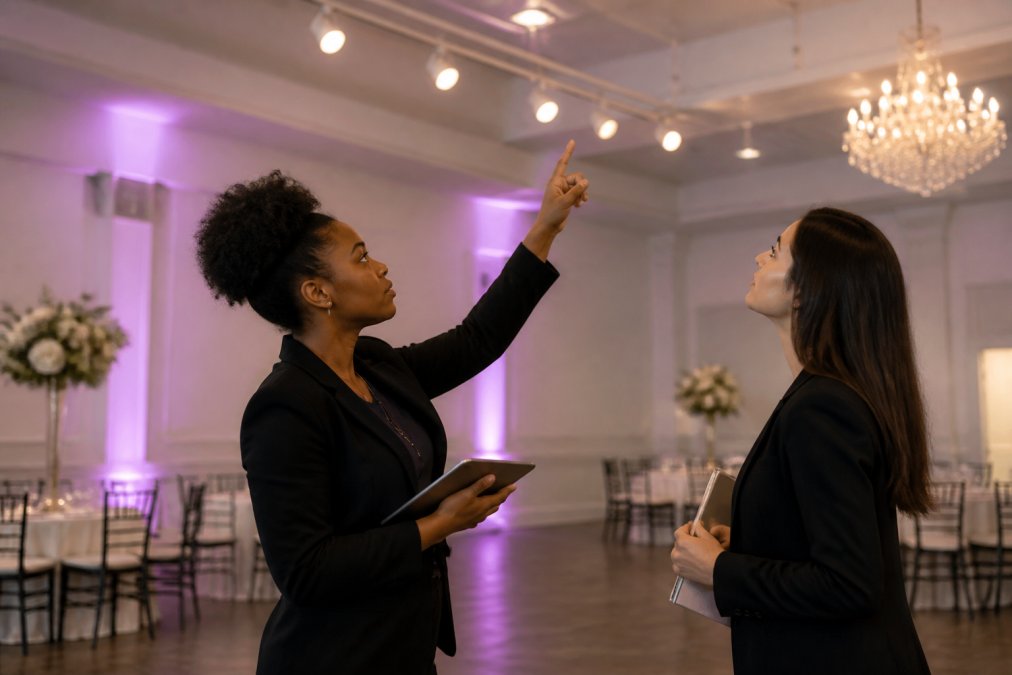
Every venue has restrictions, and discovering them after you sign is a recipe for frustration. Ask about the venue lighting restrictions before planning any custom elements. Common restrictions include limits on hanging fixtures from the ceiling, bans on candles or open flames, and rules about where uplighting units can be placed.
The contract should spell out these restrictions, but contract language is often vague. Ask the venue to walk you through the specific stipulations during your tour so you can see the constraints in context. A venue that cannot articulate its own restrictions is a red flag.
Candles, Open Flames, and Hanging Fixtures
Candles create an intimate glow that uplighting cannot replicate, but many venues restrict open flames for fire safety and insurance reasons. Ask whether flameless candles are permitted as an alternative. Hanging fixtures, such as chandeliers or string lights, require rigging points that the venue must approve in advance.
Ask about the approval process for hanging anything from the ceiling. Some venues require a certificate of insurance from the installing vendor; others restrict hanging fixtures entirely due to structural limitations. Knowing these venue lighting restrictions upfront prevents you from designing a plan that cannot be executed.
What Wedding Lighting Packages Typically Include
Wedding lighting packages vary widely by venue, but most include a baseline set of equipment: uplighting along the walls, ambient lighting for the reception space, and basic dance floor lighting. Ask the venue to itemize the package so you know what you are paying for and what will cost extra.
A typical package might include wall uplighting, a spotlight for the cake table, and dimmer switches for the main reception area. Accent lighting on draping, gobo projection of your monogram, and specialized photography lighting are often add-ons. Ask for the package breakdown in writing before you sign, and request a list of every additional element you are considering with its individual cost.
Ask the venue for photos of recent events that used their standard lighting package. This shows you exactly what the package delivers in practice, not just what it promises on paper. Compare those photos against the specific questions to ask venue for lighting about the package contents.
Event Lighting Power Requirements and Electrical Capacity
Most lighting questions stop at aesthetics, but the real constraints live in the electrical panel. A standard 15-amp, 120-volt circuit handles about 1,800 watts (osha.gov). A basic uplighting setup with 12 fixtures at 50 watts each draws 600 watts, but add a DJ system pulling 1,200 watts, and you are already near the limit. Professional lighting designers often request 20-amp circuits or dedicated 240-volt connections for larger rigs, which many venues do not have.
Ask the venue for a one-line electrical diagram or a facilities walkthrough showing where dedicated circuits are located. You need to know if the ballroom’s outlets share a circuit with kitchen refrigeration or the HVAC system, since HVAC kicking on during dinner can cause voltage drops that make LED fixtures flicker. A common pattern in older buildings is that the entire event floor runs on two or three circuits, forcing you to choose between lighting and sound.
Ask whether the venue has a sub-panel or distribution box specifically for event production. Venues that host concerts or large corporate events typically have a 100-amp or 200-amp tie-in point that a licensed electrician can access. If the venue only offers standard wall outlets, request the amperage rating for each circuit and the distance from the outlet to your planned lighting positions. Extension cords rated for 15 amps have a maximum practical run of about 100 feet before voltage drop becomes noticeable, so outlet location matters as much as capacity.
Ask about generator requirements for outdoor events. Outdoor lighting setups often need a quiet, enclosed generator rated for continuous duty, not a residential unit that cannot run for eight hours. The National Electrical Code (NEC) Article 525 covers temporary event power and requires ground-fault circuit interrupters on all receptacles used for temporary power. Ask whether the venue’s outdoor outlets are GFCI-protected and whether they have a licensed electrician on call for event day. event planning tools.
Ask about the venue’s policy on power distribution equipment. Some venues require that any distribution box, feeder cable, or multi-outlet adapter be installed by their approved electrician, which adds a line item to your budget. Others allow your lighting vendor to bring their own distro box, provided they submit a certificate of insurance and a wiring diagram in advance. Clarify whether the venue charges a fee for connecting to their power source or whether it is included in the electrical allowance.
Finally, ask the venue for a load calculation from their last major event. If they cannot tell you how many watts their system supported at a recent wedding or corporate gala, that is a red flag. A venue that understands its electrical capacity can tell you exactly how many uplights, moving heads, and haze machines you can run simultaneously without tripping a breaker.
Never assume that a venue’s standard outlets can handle a professional lighting rig. Ask for the circuit map and amperage ratings in writing before you sign. A tripped breaker during the first dance is not a minor inconvenience; it is a showstopper.
National Electrical Code Article 525 on temporary event power provides the safety baseline, and your venue should be able to confirm compliance without hesitation.
Questions About Lighting for Photography and Mood
Photography lighting needs vary dramatically by event type. A wedding reception demands warm, flattering light on faces during the first dance and cake cutting, while a corporate gala needs even, shadow-free illumination for networking and award presentations. A product launch or trade show may require accent lighting that makes displays pop without washing out projection screens. Ask the venue how their lighting system adapts to these scenarios, not just whether it can be dimmed.
For weddings, ask about the color temperature of the fixtures. Incandescent bulbs sit around 2,700 Kelvin, which produces the warm glow that flatters skin tones. Many LED fixtures default to 4,000 or 5,000 Kelvin, which reads as clinical and cool in photographs. Ask whether the venue’s fixtures are tunable across the Kelvin range or fixed at a single temperature. If they are fixed, ask for the exact rating and bring a color meter or test shot during your walkthrough.
For corporate events, ask about the lighting ratio between stage and audience. A speaker on stage needs about three times the light intensity of the audience area for cameras to expose properly. Ask whether the venue has dedicated stage lighting with front wash, backlight, and fill options, or whether the room relies on general ambient light that will make speakers look flat on video. Ask whether lighting can be zoned so the stage remains bright while the audience area dims for note-taking or screen viewing.
For galas and fundraisers, ask about the balance between table lighting and dance floor lighting. Tables need enough light for guests to read menus and auction paddles, but too much light makes the room feel like a cafeteria. Ask whether the venue offers pinspotting on centerpieces or adjustable table lamps that create pools of light without washing the entire room. Ask whether dance floor lighting can be intensified independently of the dining area, so the transition from dinner to dancing feels intentional rather than abrupt.
Ask the venue about their experience with photographers who shoot in RAW format. RAW capture gives photographers latitude to adjust white balance in post-production, but it cannot recover detail from areas that are completely blown out or lost in shadow. A venue that understands this will recommend lighting that stays within a usable dynamic range, typically between 2 and 3 stops of contrast across the room. Ask whether they have a recommended lighting setup for portrait sessions during the event, separate from the ambient reception lighting.
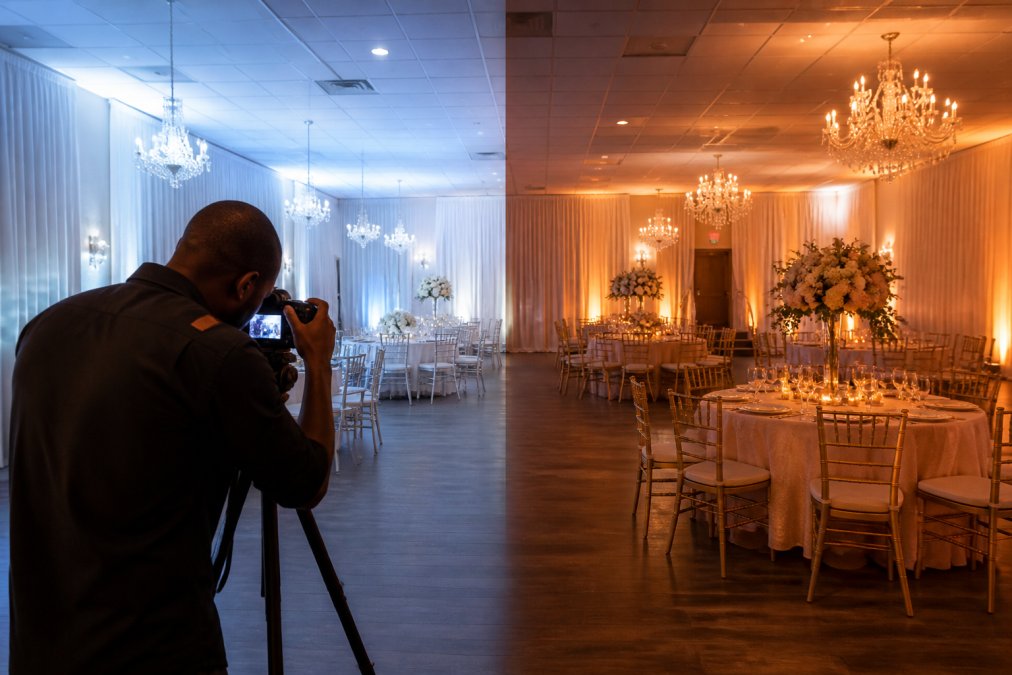
Ask about the venue’s approach to mixed lighting sources. If the room has windows that let in natural light during a daytime event, that daylight (around 5,500 Kelvin) will clash with warm indoor fixtures. Ask whether the venue has blackout shades or curtains that can be drawn to control the color temperature, and whether indoor fixtures can be adjusted to match daylight if you prefer a brighter look.
Bring your photographer to the venue walkthrough. Have them take test shots at the same time of day as your event, using the venue’s actual lighting settings. This gives you a concrete preview of how the space will look in your photos, not just how it feels in person.
Ask whether the venue has a lighting designer on staff who can create custom scenes for each phase of your event. A wedding might need five distinct scenes: ceremony, cocktail hour, dinner, first dance, and send-off. A corporate event might need three: registration, presentations, and networking. Ask whether these scenes can be programmed in advance and triggered by a single button, or whether a technician must manually adjust each fixture. The answer determines whether your timeline runs smoothly or stalls while someone fumbles with a control panel.
The right lighting questions depend on the event type. Weddings need warm, flattering tones; corporate events need even stage illumination; galas need balanced table and dance floor lighting. Ask the venue how their system adapts to your specific format, and bring your photographer to the walkthrough for a real-world test.
Conclusion: Book With Lighting Confidence
The right lighting transforms a venue from a beautiful room into an unforgettable experience. By asking the right questions to ask venue for lighting before you sign, you protect your budget, your timeline, and your photos. You also set the expectation that you are a detail-oriented client who will not accept vague answers.
M Lounge understands that lighting is the soul of an event. Our venue features professional lighting designed to elevate your celebration, from mesmerizing up-lights that wash the walls in your chosen colors to flexible controls that adapt to every moment of your evening. We pair this with luxurious venue draping and lounge furniture to create a complete, opulent atmosphere, and we welcome your detailed questions during a walk-through.
Couples and planners who want a full-service venue where lighting, draping, and furniture are already coordinated to create a cohesive, luxurious aesthetic without managing multiple vendors.
Booking a venue is a leap of faith, but it does not have to be a blind one. Ask the hard questions, demand specific answers, and choose a venue like M Lounge that treats lighting as a priority rather than an afterthought. Event planning best practices from the International Live Events Association reinforce that detailed technical questioning is the mark of a professional planner. [EXTERNAL_LINK: Reserve your date with M Lounge and let our team show you how lighting transforms a space into a timeless memory.
Frequently Asked Questions
Does the venue provide in-house lighting or do I need an outside vendor?
Always ask this first. Some venues include basic ceiling lights, while others offer full wedding lighting packages with uplighting and draping. If the venue only provides standard fixtures, you will need to hire a lighting designer who specializes in event production. Confirm whether the venue has a preferred vendor list or if you can bring your own. This answer shapes your budget and timeline, so get it in writing before you sign the contract.
Are there restrictions on the type of lighting I can bring into the venue?
Venue lighting restrictions often cover candles, open flames, and fixtures that hang from rigging points. Some venues ban certain gel colors or limit the wattage of portable lights. Ask specifically about LED uplights, pinspotting, and gobo projection, since these are common for weddings. You also need to know if the venue requires approval for third-party lighting vendors. Get the full list of restrictions in writing to avoid losing a deposit later.
Should I ask about power capacity and electrical outlets for lighting?
Yes. Event lighting power requirements are a common source of last-minute problems. Ask about the venue’s electrical capacity, the number of available circuits, and where the outlets are located. A professional lighting designer can tell you if the venue’s power distribution meets the needs of your planned setup. Confirm whether extension cords and power strips are allowed. This is especially critical for dance floor lighting and photography lighting, which draw more power.
How does venue lighting impact event photography and videography?
Venue lighting directly changes how your photos and videos look. Mixed color temperatures, such as warm ceiling lights combined with cool LED uplights, can create unflattering skin tones. Ask what lighting presets the venue offers and whether dimmer switches are available for each zone. For the best results, request a venue walk-through with your photographer to test the lighting conditions. This helps you plan accent lighting that supports mood branding without ruining your photo quality.