


Last Updated: October 31, 2026
Quick Summary
Before hiring external lighting vendors for venues, define your lighting goals and technical limits, then screen at least three candidates using the same checklist. Check insurance, technical fit, crew depth, and written contingency plans, and compare line-item quotes side by side.
- Write a brief covering event types, spaces to light, power and rigging limits, and timeline.
- Screen at least three vendors using one scored checklist rated 1-5 per line.
- Require a certificate naming the venue as additional insured, not just a standard COI.
- Ask for the name of the technician who will actually be on site, plus a named backup.
- Request written quotes and watch for extra labor, overtime, rigging, and power fees.
Table of Contents
- Why Venues Bring In External Lighting Vendors
- Step 1: Define What Your Venue Needs From a Lighting Partner
- Step 2: Use a Event Lighting Vendor Checklist to Screen Candidates
- Questions to Ask Event Lighting Companies Before You Sign
- Pricing, Quotes and Hidden Costs to Plan For
- Writing an Event Lighting Vendor Contract That Protects the Venue
- Coordinating the Venue Lighting Load-In and Load-Out Schedule
- Booking Your Lighting Vendor for Your Next Event
- Frequently Asked Questions
Venues that host weddings, corporate dinners, and milestone parties often reach a point where in-house lighting falls short. A ballroom might have decent overhead fixtures, but it rarely has the up-lights, moving heads, or wireless DMX control that a planner wants for a first dance or a product reveal.
Hiring external lighting vendors for venues is less about finding the cheapest quote and more about matching a partner’s skills to your room, your schedule, and your standards. Establishing this level of operational synergy requires the same rigorous due diligence as hiring professional contractors to ensure that every technical installation aligns with the structural integrity and long-term vision of your facility.
Why Venues Bring In External Lighting Vendors
Most venues bring in outside lighting help for three reasons: the in-house system cannot deliver the look a client wants, the venue lacks staff who can run modern fixtures, or the event calls for equipment the building does not own. A lounge with warm, low-level ambiance may need only a few up-lights, while a corporate gala may require stage washes, gobos, and automated fixtures.
External vendors also bring experience. A specialist can be expected to rig safely, plan power loads, and adjust cues when a speech runs long. That experience matters most on busy weekends when the room turns over quickly. Treating the vendor as an extension of your team, not a rental counter, is a sound approach.
Step 1: Define What Your Venue Needs From a Lighting Partner
Before you contact anyone, write down what the room must accomplish. Separate the look you want from the technical requirements. For example, “warm glow on dining tables” is a design goal, while “two 15-amp circuits available near the north wall” is a technical requirement.
Cover these points in your brief:
- Event types: Weddings, corporate meetings, and private parties call for different lighting moods.
- Spaces to light: Dance floor, head table, entrance, outdoor patio, and cocktail areas may each need separate plans.
- Power and rigging limits: Confirm ceiling load limits, available outlets, and any restrictions on hanging fixtures.
- Timeline: Note load-in windows, sound checks, and when the room must be dark or bright.
A clear brief lets vendors give accurate quotes. Vague requests produce vague proposals.
Step 2: Use a Event Lighting Vendor Checklist to Screen Candidates
Screen at least three vendors using the same criteria so you can compare them fairly. A thorough screen goes beyond insurance and photos to verify technical fit, crew depth, and event-day reliability. A venue needs to verify technical fit, crew depth, and event-day reliability before a deposit changes hands.
Build a scored checklist and rate every candidate on the same scale.
Business and risk criteria
- Certificate of general liability insurance with limits that meet your venue’s vendor requirements, plus workers’ compensation coverage
- Certificate naming the venue as additional insured (ask for the endorsement, not just the COI)
- Business license and, where required, a contractor or electrical license for any hard-wired work
- Written safety program covering rigging, ladder work, and cable management
Technical-fit criteria
- Fixture inventory list with model names, quantities, and control protocol (DMX, wireless DMX, or proprietary)
- Evidence they have worked with your power configuration, available circuits, amperage, and distance from the nearest panel
- Rigging plan that respects your ceiling load limits and approved attachment points
- Familiarity with your room’s control system or a clear plan to run their own console
- Photos or video of a comparable room, not a showreel of a stadium tour
Crew and operations criteria
- Named crew lead and technician who will be on site, with a backup named in writing
- Crew size scaled to your guest count and fixture count (a 200-guest dinner with 40 fixtures is not a two-person job)
- Load-in and load-out windows that fit your venue calendar, including freight elevator and loading dock rules
- Written contingency plan for fixture failure, power interruption, and weather for outdoor spaces
- Response-time commitment for schedule changes in the final two weeks
How to score and decide
Weight the categories to match your risk. A venue with a low ceiling and shared power should weight technical fit heavily; a venue that turns the room over twice a weekend should weight crew and operations.
Ask every candidate for the name of the technician who will actually be on site, then confirm that person is scheduled. Sales contacts and on-site crew are often different people, and the crew lead is who your event manager will rely on at 6 p.m. on a Saturday.
Where a vendor cannot answer these quickly, treat that as useful information about how well they will serve your event.
The checklist groups screening criteria into three areas that a venue should verify before any deposit is paid.
| Criteria group | What to verify | Example evidence |
|---|---|---|
| Business and risk | Insurance, licenses, safety program, references | Certificate naming venue as additional insured |
| Technical fit | Fixture inventory, power match, rigging plan, control system | Rigging plan respecting ceiling load limits |
| Crew and operations | Named crew lead, crew size, load-in windows, contingency plan | Backup technician named in writing |
| Scoring | Weight categories by venue risk; 1-5 score per line | Written note on any score of 2 or below |
Questions to Ask Event Lighting Companies Before You Sign
The right questions reveal how a vendor thinks and whether they have run events like yours. For a fuller list of questions to ask the venue about its lighting setup, see questions to ask venue for lighting.
Next, ask about logistics. Who handles delivery, setup, and teardown? How many crew members arrive for a 200-guest event? What happens if a fixture fails during dinner service? Clear answers here prevent most day-of surprises.
Finally, ask how they communicate. Will you have a single point of contact? How quickly do they reply to schedule changes?
Pricing, Quotes and Hidden Costs to Plan For
Lighting pricing depends on quantity of fixtures, rental duration, crew size, delivery distance, and whether the job includes design time. We cannot give you specific rates for M Lounge’s services or for any vendor, so request written quotes and compare line items side by side.
Watch for costs that often appear after the first estimate:
- Extra labor for load-in or load-out outside standard hours
- Overtime charges if the event runs late
- Additional fees for rigging, ladders, or lifts
- Replacement charges for lamps, gels, or cables
- Power-related costs if the venue lacks adequate circuits
Ask each vendor to list every fee in the quote, including charges for weekend or holiday service. To see which extra charges to watch for, read hidden event venue fees.
Writing an Event Lighting Vendor Contract That Protects the Venue
A written contract protects both sides and should be reviewed by your attorney before signing. The goal is not a long document; it is a document that answers the questions your event manager will be asking at 9 p.m. when a fixture fails or a wall gets scuffed. Make sure it defines the scope of work, equipment list, arrival and departure times, and responsibilities for cleanup and damage.
Clauses to require, and what each should say
- Scope of work and equipment schedule: Attach the fixture list, control system, crew size, and design deliverables as an exhibit. If the design includes programming or a lighting designer, say so and name the hours included.
- Insurance and additional insured status: Require a certificate of insurance before load-in, with the venue named as additional insured and a waiver of subrogation where your carrier requires it. Confirm the policy responds to both general liability and any auto exposure for the vendor’s truck.
- Indemnification: The vendor should indemnify the venue for claims arising from the vendor’s work, and the venue should indemnify the vendor for claims arising from the venue’s own negligence. Keep it mutual and specific rather than a one-line “vendor holds venue harmless.”
- Damage responsibility: State who pays for damage to walls, floors, ceilings, rigging points, and guest property, and how damage is documented (photos at load-in and load-out are a common mechanism).
- Cancellation and postponement: Set deadlines, deposit refund rules, and what happens if the venue must cancel for a building issue versus what happens if the client cancels.
Venue-specific risks to allocate in writing
- Power: Who provides circuits, who provides distribution, and who pays if the venue’s power is insufficient and a generator is needed.
- Rigging: Which attachment points are approved, who inspects them, and who is liable if an unapproved point is used.
- Access: Loading dock hours, freight elevator dimensions, and any union or building-staff requirements for load-in.
- Weather: For outdoor spaces, who decides to strike, who pays for a weather delay, and what equipment protection the vendor provides.
- Overtime: The hourly rate and who authorizes overtime when the event runs past the contracted end time.
Do not accept a vendor’s standard terms without reading the liability and cancellation sections. Many rental agreements shift nearly all risk to the venue and cap the vendor’s liability at the rental fee, which may be far less than the cost of a damaged floor or a ruined event.
Keep the contract specific. Phrases like “as needed” invite disputes when the night gets busy, and a clause that names a dollar figure, a deadline, or a responsible party is worth more than a page of general language.
Coordinating the Venue Lighting Load-In and Load-Out Schedule
Timing makes or breaks a lighting installation.
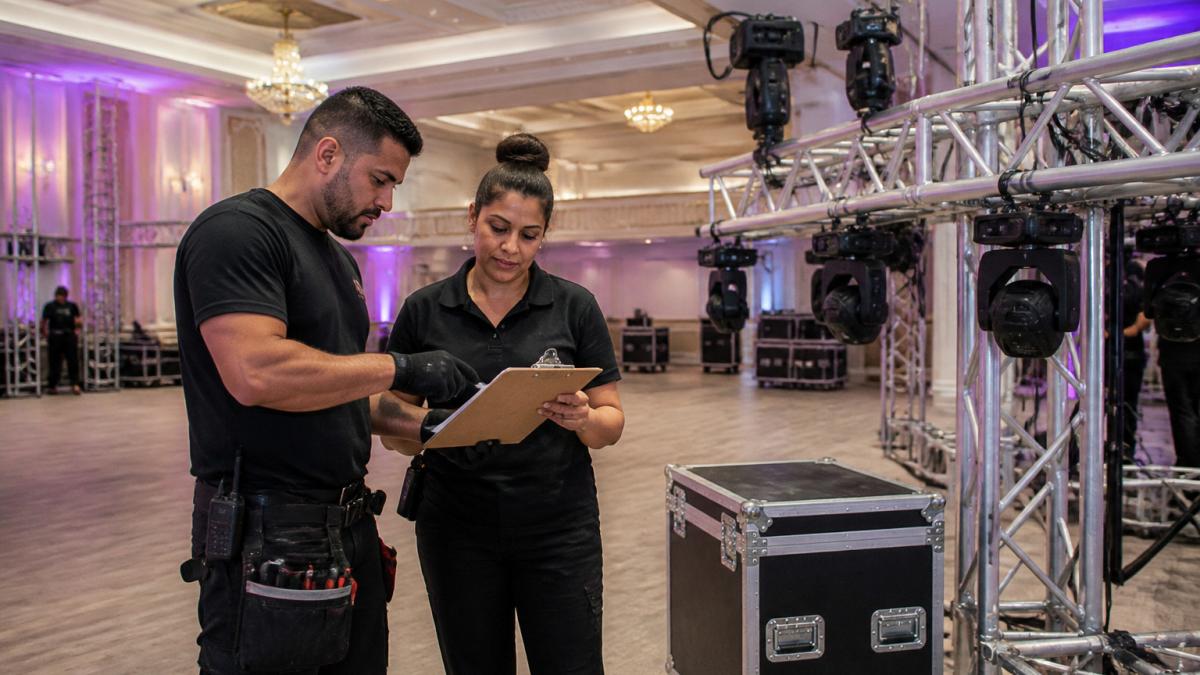
Plan load-out just as carefully. For guidance on keeping vendors informed through the whole event, see managing event vendor communication. Teardown often happens while guests are leaving, which creates tripping hazards and noise.
Watch out: Vendors who schedule load-in on the same afternoon as a rehearsal dinner often lose time to shared power and crowded hallways. Confirm access and power the day before.
Booking Your Lighting Vendor for Your Next Event
Once you have selected a partner, lock in dates early, especially for peak wedding season and year-end corporate events. For a fuller look at how a planner handles vendor selection and coordination, read how to hire a luxury wedding planner.
If you want to learn more about M Lounge’s event space, including its venue draping, professional lighting and lounge furniture, reach out to the team through the M Lounge website for a walkthrough and a written quote.
Frequently Asked Questions
How do venues choose an event lighting vendor?
Start with a short list of vendors who have done events similar to yours in size and format, such as weddings, corporate dinners or outdoor receptions. Ask each one for references, a sample site plan and proof of insurance. Compare how they handle your venue’s power, rigging limits and load-in windows, not just their equipment list. Request written quotes with identical scopes so you can compare them directly. The vendor who asks the most specific questions about your space is often the one who will run the event most smoothly.
What should a venue ask an outside lighting company before hiring them?
Ask how many years they have supplied event lighting, whether they have worked in your venue before and who will be on site on event day. Confirm their technician-to-event ratio, their backup plan if equipment fails and their process for handling changes. Ask what power and rigging they need from the venue and whether they will provide written load calculations. Clear answers to these questions reduce surprises during setup and teardown.
What insurance should an external event lighting vendor carry?
Most venues ask vendors for general liability coverage and certificates of insurance that name the venue as an additional insured. Workers’ compensation is also important if the vendor’s crew will be working at height or handling rigging. Confirm coverage limits and the policy dates before the event, and ask the venue’s own insurance team whether any additional riders are required. Keep copies of all certificates in your event file.