



Last Updated: October 30, 2026
Quick Summary
An accessible birthday party requires a ground-level or ramped entrance, wide doorways, an accessible restroom on the same level, reserved parking near a flat route, and step-free emergency exits. Confirm these details with the venue before booking, and ask about sensory comfort and digital RSVP accessibility.
- Walk the full arrival route yourself, checking door width, threshold height, and turning radius at every corner.
- Ask whether the accessible restroom stall is ever used for storage, since a stacked stall is not accessible in practice.
- Add an open-ended accommodations question to the RSVP to surface needs before you finalize the layout.
- Confirm the venue’s evacuation plan for guests with disabilities rather than assuming elevators will be available.
- M Lounge seats 80 guests and holds 100 for cocktails, with accessibility details reviewed before each event.
Table of Contents
- Why Birthday Party Venue Accessibility Features Matter
- Accessible Venue Entrances, Ramps, and Wide Doorways
- ADA Compliance for Event Spaces: What the Law Requires
- Restrooms, Parking, and Transportation Logistics
- Sensory-Friendly Birthday Party Tips for Noise, Lighting, and Comfort
- Digital Accessibility, Dietary Needs, and Emergency Planning
- Your Inclusive Party Planning Checklist Before You Book
- Reserve an Accessible Birthday Party Venue at M Lounge
- Frequently Asked Questions
Why Birthday Party Venue Accessibility Features Matter
An accessible birthday party only works when every guest can get in the door, move around the room, and stay comfortable. Anticipating these needs becomes even more critical when planning a spa party, where the environment must accommodate both relaxation and the specific mobility requirements of every attendee.
The stakes are higher than most hosts realize. Inclusive event planning isn’t a niche courtesy, it’s the difference between a guest celebrating with you and a guest staying home. Below, we’ll cover what to inspect, what to ask, and how to budget for it from day one.
Accessible Venue Entrances, Ramps, and Wide Doorways
Start with the entrance. A ground-level entrance with no step, or a properly sloped ramp as the alternative, is the first thing to verify.
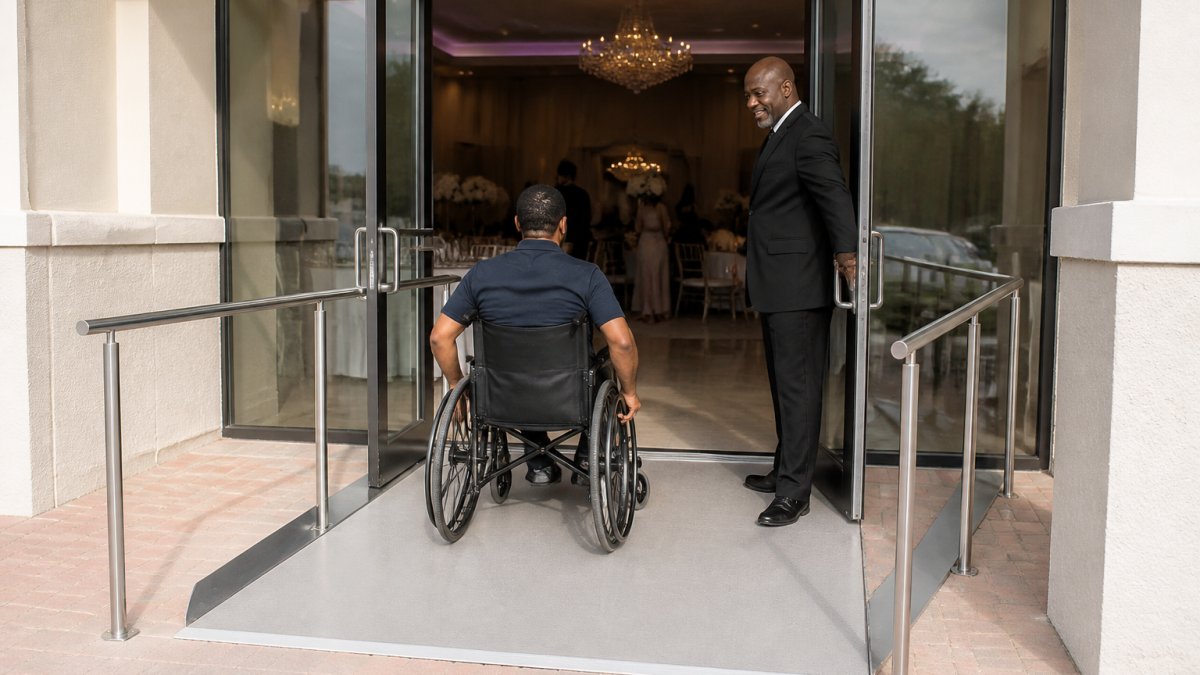
Wide doorways and clear clearance inside the room give wheelchair and scooter access real maneuverability in any room. A common mistake is measuring the door but not the turn into the hallway.
ADA Compliance for Event Spaces: What the Law Requires
ADA compliance for event spaces falls under the Americans with Disabilities Act, which sets facility standards for accessible routes, restrooms, and parking. The law is a floor, not a ceiling.
Ask the venue directly for its accessibility documentation, and confirm what’s included in the rental rather than assumed. Universal design goes further than compliance: it builds accommodating guests into the layout from the start, so nobody needs a special exception.
Restrooms, Parking, and Transportation Logistics
Reserved parking spaces near the entrance, an accessible stall with proper clearance, and a flat route to the door form the arrival experience. Event logistics break down most often here, because hosts focus on the room and forget the journey to it.
What to confirm about accessible restrooms
Accessible restrooms should be on the same level as the event space, with grab bars and enough turning room for a wheelchair. Ask the venue three specific questions rather than a general “are the restrooms accessible?”:
- Location and level: Is there an accessible restroom on the same floor as the party room, with no stairs or elevator transfer required?
- Fixtures and clearance: Does the stall have grab bars, an accessible-height toilet, and clear floor space to turn and transfer?
- Supplies and maintenance: Is the restroom stocked and checked during the event, and who do guests contact if something breaks mid-party?
You don’t need to memorize the measurements, but ask whether the venue’s restrooms were built or renovated to accessibility standards, and whether the accessible stall is ever used for storage. A stall stacked with folding chairs is not accessible in practice, even if it is on paper.
Parking, drop-off, and paratransit
Reserved parking spaces should sit on the shortest possible flat route to the entrance, with a striped access aisle so a guest can deploy a ramp or open a car door fully.
For guests arriving by rideshare or paratransit, confirm a drop-off point that doesn’t require crossing an uneven surface. Paratransit and medical-transport drivers often need a covered, curb-free spot to wait while a passenger exits, so ask whether the venue has a designated loading zone and whether staff can meet the vehicle.
Service animal accommodations
Service animal accommodations need a plan too: a relief area and a water station are small touches that signal genuine welcome. Ask the venue where a service animal can relieve itself, a strip of grass, mulch, or gravel near the entrance is typical, and whether that area is reachable without crossing the party floor. Service animals are generally permitted where the public is allowed, so a venue that balks at a service animal at the door is a red flag worth resolving before you sign (ADA Requirements: Service Animals).
Build the arrival plan into your invitation: a short line telling guests where accessible parking and the drop-off zone are, and who to call on arrival, removes the most common day-of scramble.
A quick arrival checklist
| Logistics item | What to confirm | Why it matters |
|---|---|---|
| Accessible parking | Count, location, access aisle, reserved for event | Smooth arrival |
| Drop-off zone | Curb-free, covered, lit, staff can meet vehicle | Rideshare and paratransit |
| Route to door | Flat, paved, no steps or gravel | Wheelchair and walker access |
| Accessible restroom | Same level, grab bars, turning room, stocked | Dignity and independence |
| Service animal relief area | Location, reachable without crossing party floor | Genuine welcome |
Sensory-Friendly Birthday Party Tips for Noise, Lighting, and Comfort
Sensory-friendly planning addresses the guests who won’t tell you they’re overwhelmed. Dimmed lighting, a quiet corner away from speakers, and noise reduction through soft furnishings or a separate calm room all help. Ask whether the venue can lower music volume during key moments.
Lighting affects both mood and comfort. Our guide on questions to ask a venue about lighting covers in-house versus outside vendors and who controls the lights during the event, which matters when a guest needs softer, steadier light. Guest comfort also means advance notice: an accommodations request on the RSVP lets you plan seating and sound before the day arrives.
Digital Accessibility, Dietary Needs, and Emergency Planning
Three areas most guides skip, each one where a well-meaning host most often loses a guest, before the party, at the table, or in an emergency.
Digital accessibility for invitations and RSVPs
Digital accessibility starts before the guest reaches the door. Your invitation and RSVP should work with screen readers, use readable contrast, and offer a plain-text alternative. Captioning on any video invitation helps guests who are deaf or hard of hearing. A few concrete practices make the biggest difference:
- Use real text, not text baked into an image. (Understanding Success Criterion 1.4.5: Images of Text | WAI) A JPEG flyer with the date and address is invisible to a screen reader. Send the details as text in the email body or as an accessible PDF.
- Keep contrast high. Light gray script on a pastel background looks elegant and reads poorly. Dark text on a light background is the safer default.
- Label links and buttons. “RSVP here” is fine; an unlabeled image button is not. If you use an online RSVP tool, test it with a keyboard alone, can you tab to every field and submit?
The RSVP is your best accessibility planning tool. One open-ended accommodations question on the form tells you who needs a quiet corner, a step-free route, or a dietary accommodation, before you finalize the layout.
Dietary accessibility and food service
Dietary accessibility goes beyond “are there vegetarian options?” Ask about allergens, cross-contact, and whether the caterer can accommodate medically required diets, not just preferences. Then think about how food is served:
- Buffet lines: Reaching across chafing dishes or carrying a plate through a crowd is hard for guests with mobility or balance needs. Ask whether staff can plate and serve a guest at their table, or set up a lower, reachable serving station.
- Labeling: Clear cards listing the top allergens, milk, eggs, fish, shellfish, tree nuts, peanuts, wheat, soy, and sesame, let guests decide for themselves without a public conversation with the caterer.
- Cross-contact: If a guest has a severe allergy, confirm the kitchen can prepare a separate plate with clean utensils and surfaces.
Emergency evacuation planning for guests with disabilities
This is the piece almost no party guide covers, and it matters most. Emergency egress routes should be step-free, and staff should know how to assist guests with mobility aids during an evacuation. A venue walkthrough should include these routes, not just the party room. Ask the venue:
- Are the emergency exits step-free and unlocked during the event? An exit that meets code on paper but is chained or blocked by a table is not an exit.
- Does the venue have a written evacuation plan that addresses guests with disabilities? Many commercial venues do; ask to see it.
- Who assists, and how? Confirm whether venue staff are assigned to assist guests who need help, and how they would communicate with a guest who is deaf or hard of hearing during an alarm.
Do not assume a guest using a wheelchair will use an elevator during a fire alarm. Elevators are typically recalled in a fire, and evacuation for guests with mobility disabilities usually relies on a designated assistance plan, an area of refuge, or a step-free exit route. Confirm the venue’s plan in advance rather than improvising on the day.
A short pre-party briefing, who is coming, who may need assistance, and which exit to use, takes ten minutes and closes the biggest safety gap in birthday party planning.
Your Inclusive Party Planning Checklist Before You Book
Use this inclusive party planning checklist during your tour. Bring it printed, and mark each item as you confirm it.
| Item to Verify | What to Check | Why It Matters |
|---|---|---|
| Entrance | Ground-level or ramped, no step | Wheelchair and walker access |
| Doorways | Wide enough for a wheelchair | Maneuverability inside |
| Restrooms | Same level, grab bars, turning room | Dignity and independence |
| Parking | Reserved spaces near a flat route | Easy arrival |
| Lighting | Dimmable, controllable | Sensory comfort |
| Quiet space | Available on request | Noise relief |
| Emergency routes | Step-free egress, trained staff | Guest safety |
| Digital RSVP | Screen-reader friendly | Inclusive invitations |
For a deeper look at what to inspect on your tour, see our guide on what to look for when touring event venues. And if you’re weighing whether a dedicated space is worth it, our article on why host a milestone birthday at a venue explains the broader benefits.
Reserve an Accessible Birthday Party Venue at M Lounge
M Lounge is built for celebrations that welcome everyone. Our team walks every host through accessibility details before the event, so nothing is left to chance.
Ready to see the space and confirm the details for your guests? Make a reservation for your birthday party, baby shower, or milestone celebration and let our team help you plan an event where every guest belongs.
Frequently Asked Questions
What are the ADA requirements for private event venues?
Under the Americans with Disabilities Act, places of public accommodation, including event venues, must provide accessible routes, entrances, restrooms, and parking. Title III requires barrier-free access and reasonable modifications so guests using mobility aids can attend. Ask the venue manager for their accessibility documentation and confirm details like wide doorways and reserved parking spaces before booking your accessible birthday party.
How do I know if a birthday party venue is truly accessible?
Do a venue walkthrough in person or request photos and video. Check for a ground-level entrance, ramps, wide doorways, accessible restrooms, and reserved parking spaces. Ask about sensory-friendly options like dimmed lighting and noise reduction. A venue that can answer specific questions about clearance, navigation, and accommodations requests is more likely to meet your guests’ needs.
How can I make a birthday party more inclusive for guests with disabilities?
Send an accommodations request with your invitations so guests can share needs like mobility aids, service animal accommodations, or dietary requirements. Plan a floor plan layout with clear navigation and barrier-free paths. Offer assistive listening devices and captioning if you show videos. Use these sensory-friendly birthday party tips and build an inclusive party planning checklist so no guest is an afterthought.
What questions should I ask a venue manager about accessibility?
Ask about entrance access, doorway clearance, restroom facilities, reserved parking spaces, and emergency egress plans for guests with disabilities. Confirm whether the venue provides assistive listening devices, braille signage, or tactile information. Ask how they handle accommodations requests and whether their floor plan layout supports scooter access and maneuverability. Get answers in writing before you reserve your date.
Accessibility doesn’t have to complicate a beautiful party. It just requires asking the right questions early. Get started with M Lounge and host a celebration where every guest can arrive, move freely, and enjoy the night alongside you.


Permalink